


Bonnie Ora Sherk at UCSB: When Public Space Becomes Living Art

What if a neglected strip of city land were not empty at all, but waiting for a new relationship?
That question runs through *Bonnie Ora Sherk: Life Frames since 1970*, the first major survey of the late artist, environmental educator, and landscape planner. On view at UC Santa Barbara’s [Art, Design & Architecture Museum](https://www.museum.ucsb.edu/exhibition/bonnie-ora-sherk-life-frames-since-1970/) through November 29, 2026**, the exhibition follows more than five decades of thinking about art, ecology, education, animals, infrastructure, and public space.
Sherk’s work resists the idea that art must remain inside a frame—or even inside a museum. Her projects asked what could happen when living systems became part of artistic practice and when overlooked places became sites for gathering, learning, planting, and care. The resulting work belongs to several histories at once: California Conceptual art, performance art, feminist art, social practice, landscape architecture, and environmental art.
For Santa Barbara viewers, the exhibition arrives in a place where questions about coast, habitat, development, public access, and community design are never abstract. The show offers more than a retrospective look at one artist. It offers a way to notice how a city organizes life—and how imagination can help reorganize it. 🌱

Original SantaBarbara.Art editorial artwork. This conceptual image reflects themes of infrastructure, ecology, and public space; it does not depict a real Sherk project or the UCSB installation.
A museum survey built from living questions
The AD&A Museum describes Life Frames since 1970 as the first major survey of Sherk, who lived from 1945 to 2021. Organized by Fort Mason Center for Arts & Culture in San Francisco and curated by Tanya Zimbardo, the exhibition is presented at UCSB under the curatorial direction of Ana Briz, the museum’s assistant director and curator of exhibitions.
The material on view includes newly transferred film and video, rarely seen photographs, collages, works on paper, artist books, printed matter, and archival ephemera. That range matters. Sherk often worked with temporary conditions: a performance unfolding beside traffic, a patch of sod placed where greenery was not expected, a community site evolving through participation, or an educational system designed to connect people with the ecology around them. Documentation is not an afterthought here. It is one of the ways an action in a particular time and place can continue speaking.
The survey also makes visible how consistently Sherk returned to a small set of enormous questions. Who gets to define a useful landscape? What counts as a classroom? Can an artwork be maintained, inhabited, cultivated, or shared rather than merely viewed? What changes when a “dead space” is understood as part of a living system?
Those questions feel especially relevant now, but the exhibition begins in 1970. Sherk was already treating the built environment as something that could be interrupted, reimagined, and made ecologically legible.
From urban “dead space” to Portable Parks 🌴
Sherk’s early landscape intervention Portable Parks I–III was developed in 1970 with Howard Levine. According to the AD&A Museum, the project temporarily transformed San Francisco urban “dead spaces” into living environments using elements that included sod, palm trees, and live animals.
The gesture was visually surprising, but its importance goes beyond surprise. A portable park changes the status of a place. Asphalt and leftover land can appear fixed—useful only for circulation, storage, or nothing at all. By placing living material into that context, Sherk made the assumptions around the site visible. Why was nature absent? Who decided this space had no social or ecological function? How quickly can perception change when a hard surface is interrupted by green growth?
This was not simply beautification. It was a proposition: urban space could be understood as adaptable, and art could operate through systems rather than objects alone. The work’s temporary nature sharpened that proposition. The park would not remain forever, so viewers had to compare what existed during the intervention with what returned after it ended.
That tension between the temporary and the lasting appears throughout Sherk’s practice. A performance may end, yet alter how a viewer remembers a place. A garden may change season by season, yet establish enduring habits of care. An educational project may be locally rooted, yet provide a model that travels.
Sitting still as a public action
One of the exhibition’s central images documents Sitting Still I from 1970. Sherk sat in a chair in a setting shaped by construction of the U.S. 101 freeway interchange near Bayshore Boulevard and Army Street in San Francisco. The photograph shown by the museum is credited to Robert Campbell and comes courtesy of the Bonnie Sherk Estate and Life Frames, Inc.
The action is restrained: a person sits. Yet the setting changes the meaning. Stillness beside moving infrastructure creates friction. A chair suggests a domestic interior, rest, attention, and duration. A freeway interchange suggests speed, circulation, engineering, and separation. Bringing those conditions together asks the viewer to see each one more clearly.
Sherk’s performance did not require a grand monument. It used presence, placement, and time. That economy is useful for viewers approaching conceptual or performance art for the first time. Instead of asking, “Where is the art object?” try asking:
What action is taking place?
Why is it happening in this location?
What expectations does the action interrupt?
How does the documentation shape what we know?
What remains after the action is over?
These questions can slow down a museum visit in the best way. They move attention from immediate visual appeal toward relationships: body and city, individual and system, stillness and motion.
The Farm: art as a place people could use
Sherk expanded her ecological and social approach through Crossroads Community (the farm), commonly called The Farm. The AD&A Museum identifies her as its founding director from 1974 to 1980 and notes that the experimental art-and-ecology center remained active until 1987.
The Farm reconnected parcels of land divided by freeway construction and proposed new uses for overlooked urban terrain. This was a major conceptual shift. Rather than placing an artwork into a site for a short encounter, the site itself could become an evolving social and ecological structure.
That structure blurred familiar categories. Was it an artwork, a community center, an educational environment, a landscape project, or an activist intervention? The most accurate answer may be that it was designed to hold several of those functions together.
Sherk’s practice challenges the habit of separating culture from the practical work of daily life. Planting, teaching, gathering, tending, and designing can all carry aesthetic and ethical meaning. A landscape can be composed, but it can also be cared for. A public project can create an image, but it can also create opportunities for people to meet and learn.
The museum credits The Farm with helping lay the groundwork for a broader movement to reclaim urban spaces. Sherk’s influence is therefore not limited to works that look like hers. It can also be recognized in later practices that treat vacant lots, schoolyards, gardens, and infrastructure as places where art and civic life overlap.
A Living Library: ecology as a way of organizing knowledge 📚🌿
In 1981, while living in New York, Sherk conceived A Living Library, often abbreviated A.L.L. She later established the nonprofit Life Frames, Inc. to support its educational work.
The phrase “living library” is powerful because it joins two systems we often keep apart. A conventional library organizes knowledge through books, media, archives, and access. A living landscape organizes knowledge through species, water, soil, climate, memory, use, and change. Sherk’s framework asks what becomes possible when these systems inform one another.
The AD&A Museum identifies continuing A Living Library projects on Roosevelt Island in New York and in two San Francisco locations: the Bernal Heights Living Library & Think Park Nature Walk and the OMI/Excelsior Living Library & Think Park. The A Living Library organization describes Sherk as its founding director, chief designer, and lead teacher for more than 35 years.
These projects matter because they extend artistic thinking into education and long-term stewardship. They also complicate the idea of completion. A painting can be finished and installed; a living system continues to change. Its success depends partly on relationships that must be renewed.
For a visitor, that suggests another way to look at the exhibition. Do not search only for a sequence of masterpieces. Look for the development of a method: frame a place, identify its relationships, reveal what has been overlooked, and imagine a more connected use.
Why this exhibition belongs at a teaching museum
The AD&A Museum is not simply a display venue. It describes itself as a teaching museum, and Life Frames since 1970 is built for that context. UCSB students will offer personalized tours reflecting different disciplinary interests, while the exhibition’s mix of moving image, documents, books, photographs, and proposals rewards comparison across fields.
An art student may focus on performance and documentation. An environmental studies student may notice systems and stewardship. A planner may study land use and infrastructure. An educator may see a model for place-based learning. A historian may consider how archives preserve actions that were never intended to become permanent objects.
This cross-disciplinary quality is one reason Sherk’s work feels so current. Ecological questions are never only scientific. They are also questions of design, access, culture, labor, memory, and public decision-making. Art can help hold those dimensions together without reducing them to a single answer.
The exhibition is also part of a broader effort to historicize performance art. The AD&A Museum is an educational partner in High Performance: A 2-Year Conference (2025–2027), an initiative centered on High Performance, the international magazine devoted to performance art that was published from 1978 to 1997. Sherk appeared in the magazine, connecting the survey to a wider history of artist-run publishing and performance documentation.
How to look: five lenses for your visit 👀
1. Notice the edges
Sherk repeatedly worked in spaces treated as peripheral: under freeways, beside roads, between established uses, or outside conventional art settings. When looking at a photograph or plan, pay attention to what surrounds the main action. The edge may be the subject.
2. Separate the event from its record
Ask what happened originally, then ask what the exhibition gives you now. A photograph, film, collage, book, or printed document is not identical to the live event. Each medium selects, frames, and preserves differently.
3. Follow recurring verbs
Words such as sit, plant, connect, teach, cultivate, reclaim, and frame offer a useful path through the show. Sherk’s art is often easier to understand through what it does than through what category it occupies.
4. Look for systems, not just scenes
A garden can be beautiful, but Sherk’s larger concern was relational. What connects water, soil, education, transportation, neighborhood life, and public space? Which relationship has been hidden or broken? Which one is being proposed?
5. Bring the questions home
After the visit, think about one overlooked place in your own daily route. It might be a traffic island, a blank edge of a parking lot, a fenced strip, a schoolyard corner, or a path where people already gather informally. You do not need to redesign it. Simply ask what forms of life and connection the current design permits—and what it excludes.
This attention-based exercise pairs naturally with SantaBarbara.Art’s guide to turning a coastal walk into a cyanotype-inspired creative practice. Both begin with looking closely, respecting a place, and translating observation rather than extracting from it.
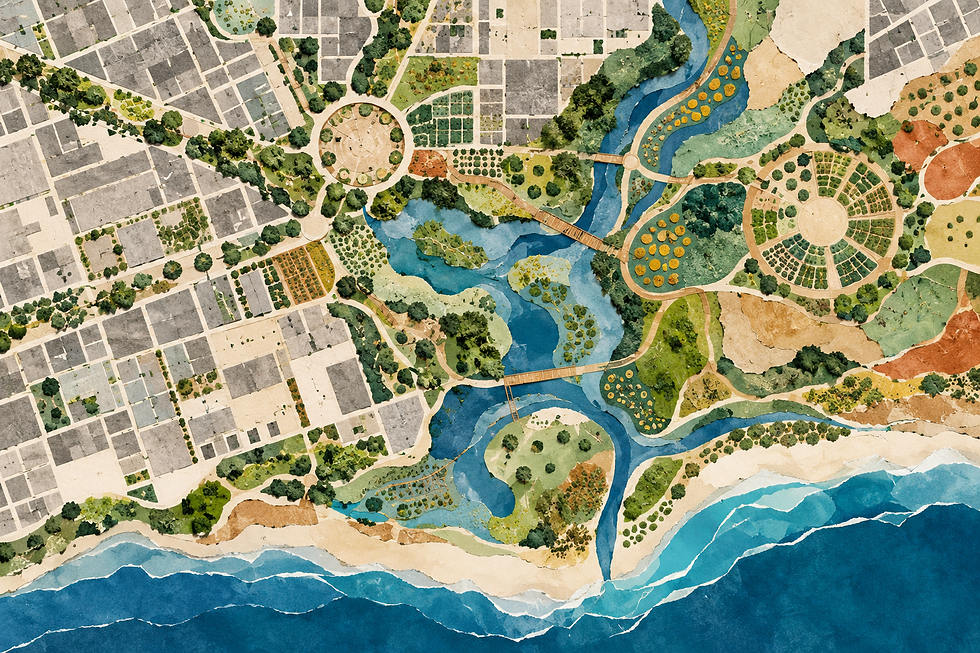
Original SantaBarbara.Art editorial artwork. This imagined map of connected “life frames” is conceptual and does not represent a real project site.
Art, ecology, and Santa Barbara
Sherk’s best-known projects emerged in San Francisco and New York, but the questions they raise resonate strongly in Santa Barbara. The city and surrounding coast bring natural beauty into daily view, yet visibility is not the same as ecological understanding. Beaches, creeks, streets, parks, campuses, habitats, and neighborhoods form connected systems even when maps and property lines divide them.
The exhibition encourages a move from scenery toward relationship. A landscape is not only something to admire or photograph. It is inhabited, maintained, governed, remembered, and changed. Public art can make those processes more perceptible.
That approach also expands what “local art” can mean. Santa Barbara’s creative identity includes studios, galleries, murals, museums, architecture, and festivals. It also includes the design of shared space and the conversations that determine how a place evolves. Projects such as Pianos on State show how an artwork can become a temporary public meeting point. Sherk’s work asks us to carry that idea further: could participation, ecology, and education become part of a place’s ongoing structure?
Visitors interested in how exhibitions use memory and imagination may also enjoy SantaBarbara.Art’s guide to As if in a Dream at the Santa Barbara Museum of Art. The two shows are very different, but both reward viewers who resist the urge to identify a single fixed meaning too quickly.
Two free programs this week
The museum has scheduled two free programs that give visitors different ways into the exhibition:
Snow Job (1970) Performance and Workshop — Thursday, October 15, noon–2 p.m. Outside the museum, a restaging of Sherk’s 1970 performance will include snow and snow cones. Inside the galleries, artist and researcher Ajani Brannum will present a durational performance and invite visitors to a performance-score writing workshop. The museum notes that formal attire is encouraged but not required. Official event details
Curator-led Tour and Talk — Friday, October 16, noon–2 p.m. Exhibition curator Tanya Zimbardo will lead a walkthrough, followed by a conversation with UCSB professor Jenni Sorkin. Official event details
Both programs are listed for the AD&A Museum with free admission. Check the linked museum pages before attending in case event details change.
Plan your visit
*Bonnie Ora Sherk: Life Frames since 1970* is on view August 26–November 29, 2026, at the Art, Design & Architecture Museum at UC Santa Barbara**.
The museum’s current visitor information states:
Hours: Wednesday–Sunday, noon–5 p.m.; closed Monday and Tuesday
Admission: Free; advance reservations are not required
Groups: Groups of 10 or more should register as a self-guided tour
Accessibility: The museum is wheelchair accessible; the closest accessible parking is in Lot 3
Parking: The museum recommends Lot 22 on weekdays and Lot 3 on weekends; its visitor page currently lists regular campus parking at $8 for a full day
Transit: Santa Barbara MTD serves the UCSB campus
Because hours, parking fees, and campus access conditions can change, confirm the latest details on the museum’s official visit page before traveling.
FAQ
Who was Bonnie Ora Sherk?
Bonnie Ora Sherk (1945–2021) was an artist, landscape architect, planner, and environmental educator. Her practice connected performance, ecological design, education, public space, and community participation. The AD&A Museum identifies her as a pioneering figure in Eco Art, Social Practice, Feminist Art, and Conceptual Art.
Is Life Frames since 1970 a new exhibition?
The survey premiered at Fort Mason Center for Arts & Culture in San Francisco in 2024. The UCSB presentation is on view at the AD&A Museum from August 26 through November 29, 2026.
What will I see in the exhibition?
The museum lists newly transferred film and video, rarely seen photographs, collages, works on paper, artist books, printed matter, and ephemera documenting Sherk’s performances and site-specific interventions.
Is the exhibition suitable for someone new to conceptual art?
Yes. Start with the relationship among action, place, and documentation. Ask what Sherk changed in a site, what assumption that change revealed, and how photographs or films allow a temporary project to be encountered later.
Is admission free?
Yes. The AD&A Museum states that admission is free and advance reservations are not required. Groups of 10 or more should register through the museum’s tour system.
How long should I allow?
The museum does not prescribe a visit length. A focused visit can work, but the range of films, photographs, books, and archival material rewards slowing down. Allow extra time if you plan to watch moving-image works or take notes.
May I photograph the exhibition?
Photography rules can vary by exhibition and by object. Ask museum staff when you arrive, especially before photographing film, archival material, or any work with rights restrictions.
What is the best source for last-minute information?
Use the official exhibition page for exhibition details and the official visitor page for current hours, parking, accessibility, and tour information.
A frame that keeps opening
The most compelling idea in Sherk’s work may be that a frame does not have to close something off. It can focus attention while opening a larger field of relationships.
At UCSB, photographs, films, drawings, books, and documents carry temporary actions into the present. Yet the exhibition does not ask visitors to stay in the past. It invites a different kind of looking outside the museum: toward the spaces between official uses, the ecological knowledge embedded in a neighborhood, and the public places whose futures are still being decided.
That is the enduring challenge of Life Frames since 1970. Do not merely add nature to the picture. Change the way the picture is organized. 🌎
Comments