


Colin Campbell Cooper in Santa Barbara: From Skyscrapers to California Light

Santa Barbara is often described through its red-tile roofs, white stucco, palms, mountains, and sea. Colin Campbell Cooper arrived with another visual language already behind him: the vertical drama of New York skyscrapers, crowded streets, railways, and modern urban movement. When he made Santa Barbara his home in 1921, he did not simply exchange one attractive subject for another. He brought decades of looking at architecture as a living part of a city—and then applied that attention to a very different landscape of arcades, gardens, sunlight, and coastal space.
That shift makes Cooper a particularly revealing figure in Santa Barbara art history. His career connects East Coast academic training, European travel, the rise of the American skyscraper, the Panama-Pacific International Exposition, and the artistic community of California’s Central Coast. It also leads to an irresistible local story: eleven works donated to the City of Santa Barbara, long thought lost, were rediscovered in the basement of City Hall in the 1970s.
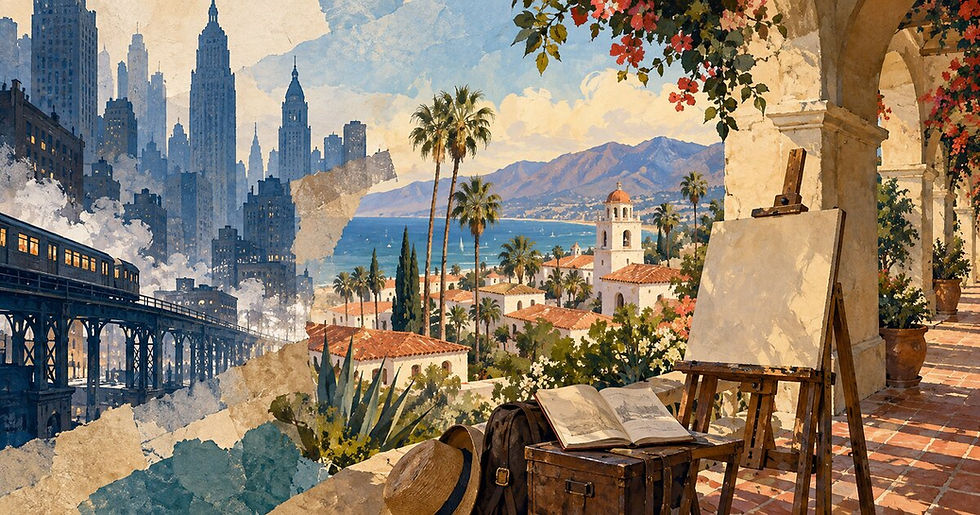
Original AI-assisted editorial illustration created for SantaBarbara.Art. It is a conceptual image—not a reproduction of a Cooper painting or documentary view of a specific place.
A painter formed by cities 🏙️
Cooper was born in Philadelphia in 1856. The Crocker Art Museum’s biography records that his early study included work with Thomas Eakins, one of the most exacting figures in American art education. In 1886 Cooper went to Europe and studied in Paris at the Académie Julian and other schools before returning to Philadelphia in 1895. He taught at Drexel Institute until 1898, then moved to New York.
Those dates matter because Cooper’s mature career unfolded during a transformation of the American city. Steel-frame construction was pushing buildings upward. Elevated railways brought motion into the visual field above the street. Commercial districts became canyons of masonry, glass, signs, smoke, and traffic. For an artist interested in the built environment, the modern city supplied an entirely new kind of landscape.
Cooper became known for urban subjects, especially New York skyscrapers. His city pictures are not neutral architectural records. They are paintings about scale, atmosphere, and human perception: the sensation of looking up, the compression of a crowded street, and the way haze or weather can soften a structure that seems engineered to dominate the skyline.
The Pennsylvania Academy of the Fine Arts holds works by Cooper, including Lower Broadway in Wartime (1917). PAFA classifies that painting as a cityscape, an apt reminder that Cooper treated streets and towers as a landscape painter might treat cliffs, rivers, or valleys. In a city, the horizon is built rather than found.
This is useful context for understanding his later California work. Cooper did not leave architectural seeing behind when he came west. He had already learned to read buildings as shapes that organize light, movement, and public life.
From vertical drama to spacious light
Cooper’s first documented California visit came in connection with the 1915 Panama-Pacific International Exposition in San Francisco. The exposition celebrated the completion of the Panama Canal and presented an enormous complex of temporary palaces, courts, gardens, sculpture, and displays. Cooper painted the fair’s architecture, including the work now known as Palace of Fine Arts, San Francisco (1916), in the Crocker Art Museum collection.
The exposition offered a bridge between two sides of Cooper’s career. It was a modern urban spectacle, yet its architecture drew heavily on historic styles and theatrical effects. It was monumental, but also temporary. And it was set within the particular atmosphere of the Bay Area, where fog, water, and western light could transform a ceremonial building from solid mass into color and reflection.
The Crocker notes that Cooper spent the winter of 1915–16 in Los Angeles and moved to California permanently in 1921. He lived chiefly in Santa Barbara for the rest of his life, dying in 1937. The move placed him in a region where architecture and landscape continually overlap: buildings frame mountain views, courtyards turn sunlight into pattern, and palms or gardens interrupt the geometry of walls.
It would be too simple to describe this as a move from gray New York to colorful California. Cooper had always been interested in atmosphere, and California cities were not untouched retreats from modern life. What changed was the spatial rhythm available to him. Instead of the close vertical pressure of Lower Manhattan, Santa Barbara offered lower buildings, longer sightlines, planted spaces, and the meeting of urban design with mountains and coast.
Santa Barbara as a second artistic home 🌴
According to the Santa Barbara County Office of Arts & Culture, Cooper lived in Santa Barbara from 1921 until his death. The Crocker biography adds that he became a leading member of the local community and served as dean of the Santa Barbara School for the Arts.
That role expands the way we should think about his local importance. Cooper was not only an established painter who happened to choose Santa Barbara as a pleasant place to work. He participated in the city’s cultural life and helped connect a growing regional art community to wider American and European traditions.
Santa Barbara in the 1920s was also actively shaping the architectural identity visitors now recognize. The city’s rebuilding after the 1925 earthquake accelerated interest in a more coordinated Spanish Colonial Revival appearance. Cooper’s Santa Barbara years therefore coincided with an unusually self-conscious period in the making of local place. An artist who had built his reputation by painting architecture was living in a city where architecture had become a central civic conversation.
That does not mean every Cooper painting should be read as a document of urban planning, or that his images provide a complete social history of Santa Barbara. Paintings select, arrange, emphasize, and omit. But they can sharpen our awareness of what a city chooses to show itself: a façade in sun, a garden threshold, a mountain glimpsed beyond a roofline, or a cultivated foreground that makes distant geography feel intimate.
For a broader view of how those elements still shape the region’s creative identity, see the SantaBarbara.Art guide to Santa Barbara’s art scene.
The City’s eleven Cooper works—and a basement rediscovery
The most direct local connection is the City of Santa Barbara’s Colin Campbell Cooper Collection. The County Office of Arts & Culture says the collection consists of eleven works: eight oil paintings and three gouaches. They were donated to the City by Cooper’s grand-niece, Sherril Henderson.
The group’s survival is a remarkable chapter in the public history of art. The works were long thought lost. In the 1970s, County Arts Commissioner Paul Mills rediscovered them in the basement of Santa Barbara City Hall. That fact can sound like the setup to a mystery novel, but the official account is spare—and it is better not to decorate it with invented details. What matters is that a locally significant body of work returned to view and could be documented, interpreted, lent, and cared for as a public collection.
Several paintings later appeared in the traveling exhibition Colin Campbell Cooper: An American Impressionist in Context in 2006–07, according to the County. The works have also been loaned to the Santa Barbara Historical Museum. Because displays and loans can change, visitors should check with the relevant institution before assuming a particular painting is currently on view.
Public collections can be easy to overlook when they are not housed in a single, permanently open gallery. Yet they are important civic records. The Cooper group preserves a connection between the artist’s national reputation and his Santa Barbara life. It also shows why collection stewardship, cataloging, and provenance research matter. Art does not remain visible by accident.
Readers curious about the decisions behind acquiring and caring for art may also enjoy The Art of Collecting: How to Build an Art Collection That Means Something.
How to look at a Cooper cityscape
You do not need a specialist vocabulary to spend time with Cooper’s work. Start with a few practical questions.
1. Where does the painting place your body?
Are you looking up at a tower, across a plaza, along a street, or through an architectural opening? Cooper often makes the viewer feel physically situated. Perspective is not only a technical system; it is a way of staging an encounter with space.
2. What does the light clarify—and what does it dissolve?
Impressionism is often summarized as painting light, but that phrase becomes more useful when made specific. Watch what happens to edges. A cornice may be crisp on one side and nearly disappear on another. Distant structures may merge with atmosphere. Reflections can make solid buildings seem fluid.
3. How does movement enter the composition?
In urban works, look for streets, vehicles, trains, smoke, flags, or small figures. These details establish pace and scale. In California subjects, the motion may be quieter: water, foliage, clouds, or repeated shadows across a wall.
4. What is architecture doing besides identifying a place?
A building can act as a backdrop, a frame, a barrier, a landmark, or the main character. Cooper’s long engagement with architecture makes his paintings valuable exercises in noticing how built forms direct attention.
5. Is the scene documentary, interpretive, or both?
A recognizable structure does not turn a painting into a photograph. Artists adjust color, omit distractions, compress distance, and choose a moment that supports the picture’s larger rhythm. The most rewarding approach is to value the work as evidence of artistic perception while using historical records for precise factual claims.
A Santa Barbara looking exercise ✏️
Cooper’s career suggests a simple creative activity that works with a phone camera, a sketchbook, or just attentive observation. Choose one short walk where architecture and landscape meet. Downtown arcades, courtyards, public stairways, planted passages, and framed mountain views all offer possibilities, but stay in public areas and respect posted access rules.
Make five images or thumbnail sketches:
A vertical view that exaggerates height.
A view through an arch, doorway, or gap.
A building edge changed by shadow.
A scene where plants interrupt architectural geometry.
A distant landmark partly softened by atmosphere.
Then compare them. Which composition feels compressed? Which one breathes? Where does the eye travel first? The point is not to imitate Cooper’s brushwork. It is to borrow his sustained interest in how structures, light, and movement shape the experience of a city.
If you would like to continue the day by seeing contemporary work, the SantaBarbara.Art guide to Santa Barbara art galleries offers a starting point. Confirm current hours and exhibition details directly with each venue before visiting.
Why Cooper still matters to Santa Barbara
Cooper’s Santa Barbara story is not merely a local footnote to a New York career. It reveals an artist adapting a lifelong subject—architecture—to a new environment. His move west connects skyscraper modernity with California atmosphere, national art networks with regional teaching, and private family stewardship with a municipal collection.
It also offers a more layered way to see Santa Barbara. The familiar beauty of the city can become visually automatic: tile, stucco, palm, mountain, repeat. Cooper’s example invites slower looking. How high or low is the horizon? What does a shaded arcade do to the brightness beyond it? How does a façade organize the space around it? What makes a street feel ceremonial, intimate, busy, or still?
These questions remain contemporary because cities are always being re-seen. Every generation inherits buildings and images, decides what to preserve, and creates new visual stories about where it lives. Cooper’s work belongs to an earlier moment, but the act of paying close attention to the built environment is never finished.
Frequently asked questions
Who was Colin Campbell Cooper?
Colin Campbell Cooper (1856–1937) was an American painter associated with Impressionism. He was known especially for architectural and urban subjects, including New York skyscrapers, and later for California scenes. He studied in Philadelphia and Paris, taught at Drexel Institute, and became a member of the National Academy of Design.
When did Cooper live in Santa Barbara?
Cooper moved to California in 1921 and lived chiefly in Santa Barbara until his death in 1937. He became active in the local art community and served as dean of the Santa Barbara School for the Arts.
How many Cooper works does the City of Santa Barbara own?
The City owns eleven works donated by Cooper’s grand-niece, Sherril Henderson: eight oil paintings and three gouaches, according to the Santa Barbara County Office of Arts & Culture.
Were the City’s Cooper paintings really found in a basement?
Yes. The County’s official collection history says the works had long been thought lost and were rediscovered in the basement of Santa Barbara City Hall in the 1970s by County Arts Commissioner Paul Mills.
Where can I see Cooper’s work?
Start with the County Office of Arts & Culture’s online collection information and the official collection pages of institutions such as the Crocker Art Museum and the Pennsylvania Academy of the Fine Arts. Locally, Cooper works have been loaned to the Santa Barbara Historical Museum, but displays change; check directly with the museum before visiting.
Did Cooper only paint Santa Barbara?
No. His career included European subjects, East Coast cityscapes, New York skyscrapers, the Panama-Pacific International Exposition in San Francisco, and other California scenes. Santa Barbara was his principal home during the final sixteen years of his life.
Is the illustration in this article a Cooper painting?
No. It is original AI-assisted editorial artwork created for this article. It conceptually connects Cooper’s urban and California subjects but does not reproduce a specific painting or document an actual historical scene.
Continue exploring Santa Barbara art
Cooper’s journey from Philadelphia and New York to Santa Barbara belongs to a larger story of artists, institutions, collectors, and public spaces shaping the region’s visual culture. Continue with the Santa Barbara art scene guide, browse the gallery guide, or explore the County Office of Arts & Culture collections to see how art enters the civic record.
Cooper’s lasting lesson is beautifully simple: a city changes when we learn to look at it. 🎨
Comments