


As if in a Dream at SBMA: A Visitor’s Guide to Memory, Fantasy, and the Future

Updated: Sep 28
Some exhibitions ask you to identify a subject. As if in a Dream: History, Fantasy, Future asks a more unsettling question: what happens when a familiar subject begins to slip? A landscape may carry the colors of childhood rather than the fixed features of a map. A figure may look mythic while holding a private family history. An ordinary object may seem to have wandered in from a possible future. At the Santa Barbara Museum of Art (SBMA), those shifts are the point. 🌙
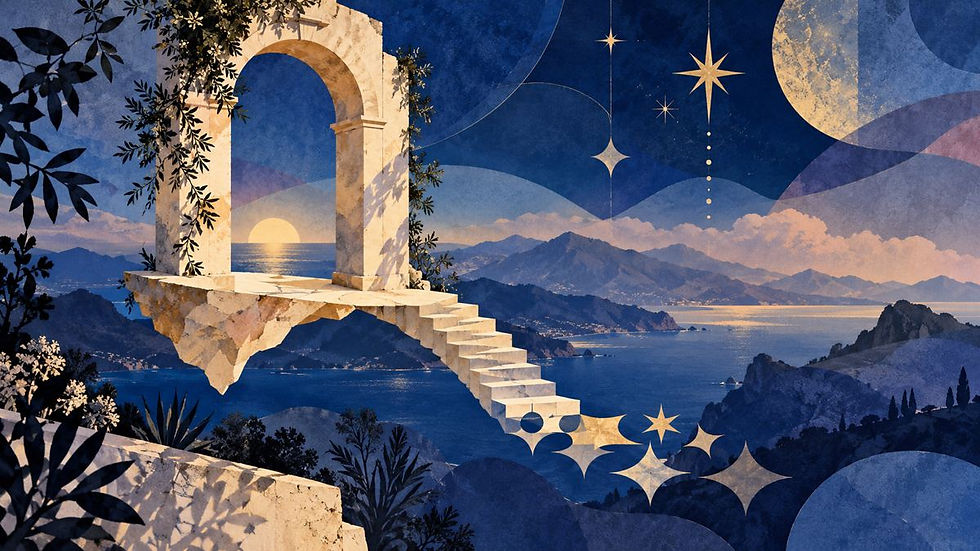
Original SantaBarbara.Art editorial illustration: an imagined arch and stair above an indigo coast. It interprets the exhibition’s themes; it does not depict an exhibited work, the museum, or an actual view.
On view March 8, 2026–January 3, 2027, the exhibition brings together works chiefly from SBMA’s collection, with some loans, across the McCormick, Wasserman Family, and Davidson galleries. The museum describes two broad groupings—landscapes and bodies, mostly human—and a shared interest in turning experience, memory, and imagination into art. That structure gives visitors a useful way in, but it is not a test to pass. You can walk slowly, notice what feels recognizable, and then ask what an artist has changed. See SBMA’s exhibition page for the museum’s current presentation and dates.
A dream is a way of looking, not one visual style
The title might suggest mist, sleep, or surreal imagery. Those associations help, but they do not describe everything here. SBMA’s premise is broader: art can begin with a real place, a remembered color, a person known to the artist, or a familiar household object, then reorder those ingredients until they feel strange. Dreams do something similar. A memory can remain emotionally precise even when its setting has changed.
That idea makes the exhibition inviting to viewers who do not know the artists already. Start with a simple sequence of questions. What can you name? What refuses to settle into a straightforward account? Does the uncertainty feel playful, eerie, tender, or hopeful? The answers will differ from work to work, and your first reading may change as you move through the galleries.
The show also resists the notion that imagination is an escape from history. A family member, childhood environment, inherited story, or experience of the present can become the raw material for an image that looks fantastic. The real source does not disappear; it becomes more complicated. This is a useful lens for the whole visit, whether you gravitate toward painting, sculpture, or installation.
Begin with landscapes: places we remember and places we invent 🏞️
The museum places landscapes in one of the exhibition’s two main sections. A conventional landscape often invites us to recognize a location. Here, recognition can be only the beginning. SBMA’s exhibition press release points to Edward Chávez’s Elemental Landscape (1956) as a work associated with the geology of New Mexico and Colorado, where he spent childhood years. That background matters, yet a remembered environment is never quite a survey of terrain. It can hold feeling, distance, and a sense of identity at once.
Alice Baber’s Wheel of Day (1971) offers another way to consider place. SBMA connects it to the artist’s interest in “color memories” and to childhood recollections especially strong in color. Think about your own memory of a summer afternoon. Perhaps you can recall its heat, light, or palette more readily than the exact arrangement of buildings. A painting can give that kind of impression form without pretending to reconstruct every detail.
For a visitor, the difference between geography and remembered geography can be productive. Stand back to take in the image’s overall rhythm, then come closer and notice how color, edge, and scale alter your sense of place. Ask whether you feel oriented. If the work seems to shift under your gaze, that may be the experience the artist wants you to inhabit.
Max Hooper Schneider’s Intertidal Arroyo (2025) pushes the landscape idea toward a more speculative world. SBMA describes a mixture of reef and dollhouse elements, with programmed screens among its materials. Rather than treating it as a prediction, consider what its unlikely combination makes visible about nature, technology, and human design. A strange landscape can reveal familiar habits of thought by rearranging them. The museum’s release lists its materials and identifies it as a recent acquisition; the work is an especially good reminder to read the label after allowing yourself an initial impression.
These examples do not have to resolve into one message. Their value together is the range they give to a single word: landscape. It can be an exterior place, an interior recollection, or an imagined environment that seems to look back at the present.
Then turn to bodies: when a portrait holds more than a likeness
The second grouping centers on bodies, primarily human ones. Portraits can seem easier to read than landscapes because we instinctively search faces for expression and story. Yet a viewer’s access is always limited. A face tells us something; it does not grant us the subject’s memories or thoughts.
SBMA describes Rafael Coronel’s Rosa en el pasillo (1967) as an image whose figure may appear timeless or mythological. The museum also identifies the subject as the artist’s grandmother. That fact changes the encounter without exhausting it. What first seems remote can turn out to be intimate; a family relationship can be carried in a visual language that exceeds ordinary portraiture. Let that tension remain rather than trying to choose between “real person” and “symbol.”
A portrait by Dominic Chambers offers another kind of uncertainty. According to SBMA, its stylishly dressed subject might be reading, daydreaming, or looking into the distance. The museum emphasizes that his thoughts remain unavailable to us. It is a careful point. Viewers often supply a story too quickly, especially when an image feels quiet. Here, the unanswered question is part of the work’s power. What can you actually see, and what are you inventing?
The exhibition also includes works by artists such as Alison Saar, Odilon Redon, Lari Pittman, and others named on SBMA’s current exhibition page. Each has a distinct practice. Resist the urge to flatten them into a single “dreamlike” style. The stronger connection is a shared opportunity to consider how bodies can carry memory, vulnerability, projection, and possibility.
What changes when an everyday object becomes strange?
One of the works featured on SBMA’s exhibition page is Jorge Pardo’s Untitled (Sea Urchin) (2012), an object that joins a sea-urchin form with the functional language of a lamp. The materials listed by the museum include aluminum, molded Plexiglas, canvas, electrical components, and lightbulbs. It is a helpful example of how fantasy need not depend on a distant landscape or a fictional character. An altered relationship between familiar categories—sea life and domestic lighting—can do the work.
Try asking where your expectations came from. Is a lamp supposed to be merely useful? Is a sea urchin supposed to remain in the sea? When an artist makes those categories collide, humor and unease can arrive together. The result can also prompt closer attention to shape and material, qualities we might overlook in an ordinary household object.
SBMA’s gallery images also show paintings by Giovanni Paolo Panini, Odilon Redon, and Tom Wudl. Their dates, media, and subjects vary widely. Seeing such works in one exhibition encourages comparison without claiming that they mean the same thing. Instead of hunting for a single visual signature, watch for the moment each image changes the rules of its own world.
A practical way to explore the exhibition
You do not need specialist vocabulary to enjoy this show. A little structure can help you avoid racing from label to label. Try the following approach as a personal exercise, not a museum-prescribed route.
First, spend a minute with a work before reading its wall text. Notice one concrete detail: a color transition, object, gesture, material, or unlikely pairing. Describe it to yourself without interpreting it. “A figure stands in a corridor” is different from “the figure feels isolated.” Both may be worthwhile observations, but keeping them distinct lets you see how your interpretation forms.
Second, identify the shift. What makes the image depart from ordinary expectation? It may be scale, a collision of objects, a setting that cannot quite be mapped, or a face that withholds a clear story. In a landscape, ask whether you feel like a traveler, a witness to memory, or someone looking into an invented future. In a portrait, ask how much you truly know about the person shown.
Third, read the label and the museum’s interpretation. A title, date, material, or biographical connection can open a new path. It may also unsettle your first assumption. That is not a mistake; it is one of the pleasures of looking closely. Return to the work for another minute and see what changed.
Finally, choose two works from different sections and place them in conversation. Does a remembered landscape speak to a figure’s inward life? Does a sculptural object make a painted world seem more physical? This exercise can turn a large exhibition into a set of memorable encounters rather than a checklist.
Why this exhibition belongs in a Santa Barbara art day 🎨
Santa Barbara has many ways to spend an art-focused afternoon, from museum galleries to independent spaces and outdoor discoveries. This exhibition offers a particularly open-ended stop: it gives you a theme to carry with you after you leave. Once you have looked for the unstable boundary between observation and imagination indoors, you might notice it in a familiar street, a building facade, or the changing light on the coast.
That is an invitation to your own creative practice, not a claim that the exhibition depicts those local places. A sketchbook prompt could be as simple as drawing a place from memory before consulting a photograph. A photography prompt could be to frame a reflection so that an ordinary scene becomes ambiguous. If you want a more hands-on coastal project, our guide to Santa Barbara coastal cyanotypes explores how to turn observations and photographs into art while respecting the shoreline.
For visitors building a larger itinerary, our Santa Barbara art scene guide offers more context. Check individual venues directly before setting out; exhibitions, admission, and opening hours can change.
Plan your visit to SBMA
The Santa Barbara Museum of Art is at 1130 State Street, Santa Barbara, CA 93101. As listed on the museum’s current exhibition page, regular hours are Tuesday through Sunday, 11 a.m.–5 p.m., with extended hours on the first Thursday of each month, 11 a.m.–8 p.m. The museum is closed Mondays and holidays. Because schedules can change, consult SBMA’s visit information and ticket page before traveling, particularly around holidays. We are not listing an admission price here because the museum is the best source for current rates and eligibility.
The exhibition is scheduled through January 3, 2027. If you are planning around a particular work, remember that a museum presentation can change during a long run. SBMA’s current exhibition page is the best place to confirm what is on view; museum staff can answer work-specific questions. For accessibility needs, use the museum’s accessibility information or contact the museum directly before your visit.
Allow yourself time to pause. A show about memory and fantasy rewards revisiting a work after you have seen another one. The experience is not measured by how many names you retain. If you leave with one image that keeps changing in your mind, the exhibition has already given you something to carry.
Frequently asked questions
Is As if in a Dream open now?
Yes. SBMA lists the exhibition as running from March 8, 2026 to January 3, 2027. Check the official exhibition page before visiting for any updates.
Where is the exhibition?
It is at the Santa Barbara Museum of Art, 1130 State Street. SBMA lists the McCormick, Wasserman Family, and Davidson galleries for the current presentation.
What kind of art will I see?
The exhibition draws mainly from the museum’s collection, with some loans, and groups works around landscapes and bodies. SBMA names artists including Alice Baber, Dominic Chambers, Rafael Coronel, Max Hooper Schneider, Giovanni Paolo Panini, Jorge Pardo, Odilon Redon, Alison Saar, and Tom Wudl. Consult the museum’s current page for the full artist list and displayed works.
Do I need to know art history to enjoy it?
No. Begin with what you see, notice what feels familiar or surprising, and use the labels to deepen your reading. The exhibition’s central ideas—memory, imagination, and how we picture a future—are accessible starting points.
Is the illustration in this article a picture of the exhibition?
No. It is original AI-assisted editorial artwork created for SantaBarbara.Art. It is an imaginative response to the theme and does not reproduce an exhibited work or document the galleries.
What are the museum’s hours and admission?
SBMA currently lists Tuesday–Sunday, 11 a.m.–5 p.m., first Thursdays until 8 p.m., and Monday and holiday closures. See the museum’s official website for current tickets, prices, exceptions, and accessibility details before you go.
Take the question home
The strongest reason to see As if in a Dream may be the question it leaves behind. How much of a place do we remember accurately, and how much do we remake each time we picture it? How much can we know about a person from an image? When does an object stop being ordinary? SBMA’s exhibition puts those questions in conversation across different works and eras. Your own memories will supply another layer. ✨
For the full exhibition description and the latest visitor details, start with SBMA’s official exhibition page.
Comments