


Pianos on State 2026: A Guide to Santa Barbara’s Public Art You Can Play

For three weeks this fall, an ordinary walk through downtown Santa Barbara can turn into an open-air encounter with color, sound, and spontaneous performance. Pianos on State returns September 29–October 19, 2026, placing artist-painted pianos along State Street and at select nearby locations for the public to play, hear, and enjoy. 🎹🎨
The project is unusually welcoming because it does not ask visitors to choose between looking at art and participating in it. Each piano is a public artwork, a working musical instrument, and a temporary gathering place. A passerby can study the painted surface, sit down to try a melody, pause for an unexpected performance, or simply watch strangers become an audience.
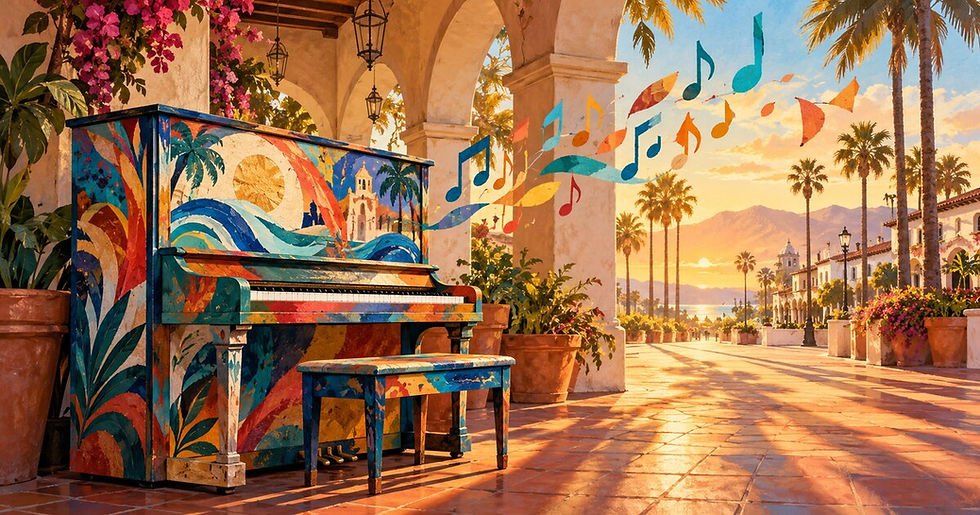
Original SantaBarbara.Art editorial illustration: an imagined painted piano beneath Santa Barbara–inspired arcades. This conceptual image does not depict a real 2026 piano, artist design, location, or event scene.
The official Pianos on State website identifies the Santa Barbara Bowl as the 2026 presenting sponsor and describes the invitation in three words: “Play • Listen • Enjoy.” The Santa Barbara County Office of Arts & Culture confirms that the installations appear downtown and at other select locations, while the project’s official map offers current directions. That makes this a particularly easy art outing to build around a downtown walk—free, flexible, and open to both musicians and people who have never touched a keyboard.
What exactly is Pianos on State?
Pianos on State is an interactive public art and music program of the Santa Barbara Arts Collaborative, created with local partners. Artists transform upright pianos into distinct visual works, and the finished instruments are installed in public spaces where people can play them.
The idea sounds simple, but it collapses several boundaries that usually shape an arts experience. A museum protects an artwork from touch; this project depends on touch. A concert establishes performers and an audience; a public piano lets those roles change from one minute to the next. A mural generally stays in one place; these decorated instruments arrive for a limited season and then disappear from the streets.
That combination is why the pianos matter as more than cheerful street furniture. They make creativity visible as a shared action. The person who painted the case, the person improvising a song, the child pressing a first note, and the listeners who stop for a moment all contribute to the life of the work.
The program’s official 2026 call described the painting process as a weekend at the Community Arts Workshop where artists of different styles work alongside one another, trade knowledge, and make art together. Selected individual artists and teams received a $700 materials stipend and were provided with a piano and workspace for the September 25–27 painting period. Applications for 2026 are now closed, but those details reveal an important part of the project: the public display begins with a temporary artist community behind the scenes.
The essential 2026 details 📍
According to the project organizers, the 2026 pianos are on view September 29 through October 19. The official source is the Pianos on State map page, which links visitors to directions for each location. Because instruments may be distributed beyond a single block, check that map on the day of your outing rather than assuming every piano will be directly on State Street.
Visit Santa Barbara lists the event as free and identifies the Santa Barbara Arts Collaborative as the host. The public is invited to explore the instruments and enjoy impromptu playing. You do not need a ticket or a formal performance reservation to experience the installations. For current conditions, location changes, or event notices, use the organizers’ website rather than relying on an old social post or map screenshot.
The pianos are temporary outdoor installations, so practical conditions can matter. Weather, maintenance, nearby programming, or a busy downtown moment may change what you encounter. Approach the project as a self-guided art walk with room for surprise.
Why a painted piano is different from a mural
Santa Barbara already has a rich relationship with art in shared space. Murals, sculpture, architecture, storefronts, and seasonal installations all shape how the city looks. Our guide to Santa Barbara’s street art and murals explores another side of that public visual culture. Pianos on State adds sound, physical participation, and performance.
A mural changes a wall by turning its surface into an image. A painted piano changes in at least three ways at once. First, the case becomes a visual composition that must work across a box-like, irregular form. Second, the keyboard remains functional, inviting the public to activate the object. Third, every performance changes the social space around it. A quiet corner can become a miniature venue in seconds.
The instrument also carries a cultural history before an artist paints it. Upright pianos are associated with living rooms, schools, rehearsal spaces, churches, theaters, and lessons. Moving one into the street unsettles those expectations. The piano is no longer private furniture or a formal concert instrument. It becomes a civic object: familiar enough to invite recognition, unusual enough to make people stop.
Look closely at how each artist responds to that form. Does the design treat the front panel like a canvas? Does it follow the piano’s edges, legs, lid, or keyboard? Does the bench participate in the visual idea? A strong public-art design has to communicate from several distances. It may first appear as a burst of color from across the street, then reveal finer marks when you approach.
A five-step art walk for curious visitors 🚶
You can see the pianos casually, but a simple framework makes the experience richer. Begin with the official map and choose a manageable route. Downtown Santa Barbara invites detours, so allow more time than a straight-line estimate suggests.
1. Look before you listen
When you reach a piano, pause before reading any nearby information or waiting for someone to play. Notice its dominant colors, the way the design wraps around the instrument, and the details that only appear up close. Ask what the artist has done with the piano as a three-dimensional object rather than treating it as a flat picture.
2. Read the credit
Public art can become anonymous when people photograph the object but omit its maker. Look for the artist credit and include it if you share an image. If the work was created by a team, credit the team as the project presents it. The official website says participating artists are recognized through project materials; those names are part of the work’s story.
3. Listen to the space
If someone is playing, notice the full soundscape. Piano notes mingle with conversation, footsteps, traffic, birds, and the acoustics of surrounding buildings. That mixture is not the controlled environment of a concert hall. It is a portrait of a living downtown.
4. Participate respectfully
If the piano is available and you want to play, treat it as a shared public instrument. A short piece, a few chords, or careful experimentation can all belong. Give other people room, keep food and drinks away from the keys, and follow any posted guidance. Participation does not require virtuosity; it does require consideration.
5. Compare two pianos
At the next location, ask what changed. One artist may use bold imagery that reads from afar, while another rewards close observation. One location may feel theatrical and busy; another may make the same instrument seem intimate. Comparing two encounters reveals how artwork, architecture, and audience shape one another.
A guide for photographers and social sharing 📷
Painted pianos are naturally photogenic, but documentation should preserve context and authorship. Photograph the entire instrument before moving in for details. Capture a side panel, the keyboard, the bench, and the surrounding public space when doing so does not interfere with players or pedestrians.
Avoid presenting a generated or heavily altered scene as documentary evidence of the event. The illustration in this article is intentionally identified as conceptual. If you photograph an actual installation, label it with the artist’s name and location when those details are available. Do not remove signatures or project signage from a crop if they help viewers understand who made the work.
People deserve care too. A wide photograph of a public setting is different from a close portrait of a performer or child. Ask before making someone the identifiable subject of your image, especially if you plan to publish it. A musician may be happy to be recorded—or may simply be enjoying a private moment in public.
For a creative exercise, make a three-image sequence: one frame showing the piano in its urban setting, one revealing a painted detail, and one focusing on the traces of participation—the keyboard, bench, or gathered audience. The sequence can tell a fuller story than a single centered snapshot.
For musicians, beginners, and people who only want to listen
The public invitation includes amateurs and experienced musicians, but “public” does not mean you must perform. Listening is a valid way to participate. The unpredictable shift between silence and music is one of the project’s pleasures.
Beginners can choose a quiet moment and explore gently. Try a simple scale, a familiar melody, or a pair of chords. Parents can help children take turns rather than treating the instrument like a toy to strike. Experienced players can offer a short piece while remembering that the space belongs to everyone, not to a booked recital.
If a crowd forms, the social rules are intuitive: let the current player finish, applaud when it feels natural, and allow others a turn. Do not pressure a person sitting at the piano to perform. A public instrument creates possibility, not obligation.
The condition and tuning of outdoor pianos can vary. That variation is part of the encounter, but it also means musicians should not expect the consistency of a maintained concert instrument. Listen to what the piano offers that day and adapt.
How Pianos on State supports a creative downtown
Public art changes the pace of a street. A person walking toward a store, restaurant, bus stop, or appointment may suddenly stop because someone has begun to play. Strangers who would otherwise pass without acknowledgment share a few minutes of attention. That temporary audience is a small but meaningful form of community.
The project also connects different parts of Santa Barbara’s creative ecosystem. Visual artists create the designs; musicians activate the instruments; organizers coordinate public placement; sponsors and partners make production possible; downtown businesses and pedestrians live alongside the result. No single group owns the complete experience.
This collaborative structure fits Santa Barbara’s broader tradition of artists meeting the public outside conventional galleries. The weekly Santa Barbara Arts & Crafts Show places local makers in direct conversation with visitors along the waterfront. Pianos on State creates a related kind of accessibility downtown, but with an object that can become both artwork and stage.
The limited duration matters. Temporary art can encourage people to look now rather than postponing indefinitely. It can also make room for new artists and new designs in future seasons. The city does not receive one permanent image; it receives a recurring process of reinvention.
Build a wider Santa Barbara art day
A Pianos on State walk can stand alone, or it can anchor a longer day of local culture. Start by checking the official map and selecting a few piano locations. Add an independent gallery or museum whose current hours you have verified directly. If you continue toward the waterfront, the Arts & Crafts Show operates on designated Sundays, not every day, so confirm its official schedule before combining the two.
You might also extend the outing toward the Funk Zone, where galleries, studios, murals, and converted industrial spaces offer a different relationship between art and neighborhood. Our guide to art in the Funk Zone can help frame that visit. Do not try to cover everything. Two or three pianos, one gallery, and time for a meal can make a more attentive itinerary than a rushed checklist.
Accessibility should be part of route planning. Downtown sidewalks and crossings vary, construction can alter paths, and a map pin does not always explain the easiest approach. Visitors using wheelchairs or other mobility devices may want to review the route block by block and allow for detours. The project site provides location directions; for temporary street conditions, consult current City information.
Frequently asked questions
When is Pianos on State 2026?
The official project website and Santa Barbara County Office of Arts & Culture list the installation dates as September 29–October 19, 2026.
Where are the pianos located?
They are placed along State Street and at select additional locations. Use the official 2026 map for current directions rather than relying on a previous year’s route.
Is Pianos on State free?
Yes. Visit Santa Barbara lists the event as free. You can walk the route, look, listen, and play without an admission ticket.
Can anyone play the pianos?
The project invites public musical exploration by amateur, professional, and other community musicians. Be considerate, follow posted instructions, protect the instrument, and share time with others.
Who paints the pianos?
Local artists and artist teams selected through the project’s application process create the designs. The 2026 application period is closed. The official call says selected participants received a materials stipend and painted at the Community Arts Workshop.
Are the pianos permanent?
No. The 2026 public display is scheduled to end October 19. The project returns seasonally with new activity rather than presenting these pianos as permanent street fixtures.
Is the image in this article a real Pianos on State installation?
No. It is original AI-assisted editorial artwork made for SantaBarbara.Art. It evokes the idea of a painted public piano but does not reproduce an artist’s design, document the 2026 event, or show an actual downtown location.
How can I credit an artist when posting photos?
Check the signage attached to or displayed near the piano and the official project materials. Include the artist or team name when available, and avoid presenting their painted design without attribution.
The art begins when somebody stops
Pianos on State succeeds through a chain of invitations. An artist accepts the unusual shape of a piano as a surface. Organizers move that instrument into public space. A musician decides to sit down. A passerby chooses to pause. For a few minutes, downtown becomes a gallery and a stage without asking anyone to cross a threshold. ✨
That makes the best way to experience the project wonderfully simple: consult the official Pianos on State website, choose a small route, look closely, listen generously, and leave space for someone else to join in.
Comments