


The Santa Barbara School of the Arts: A Creative Campus That Helped Shape a City

Santa Barbara’s art history is often told through individual names: a landscape painter drawn to the coast, an architect who found a language for local buildings, or a printmaker who carried images of the West far beyond California. But an art community needs more than gifted individuals. It needs places where people can learn, test ideas, encounter one another’s work, and eventually teach the next generation. In the early twentieth century, the Santa Barbara School of the Arts became one of those places.
The school’s story is not a tidy institutional timeline. The Santa Barbara Historical Museum dates its founding to 1920 and describes seventeen years of teaching. The Santa Barbara Trust for Historic Preservation describes a 1922 opening as part of the Community Arts Association and says the school survived until 1932, when Depression-era funding dried up. The Historical Museum’s archive authority record uses 1920–1938. Those sources may be marking different stages—founding, formal association, regular operation, and later institutional activity—but they do not establish a single uncontested closing date. The important common ground is clear: for roughly a generation, the school helped turn a community of artists into a community of artistic learning.

Original conceptual editorial illustration for SantaBarbara.Art. The colorful workspace is imagined; it does not depict an actual School of the Arts classroom, building, student, or historical artwork.
Why a school mattered here 🎨
The Historical Museum’s account of the arts movement traces the South Coast’s reputation as an art colony to the late nineteenth century. It names Henry Chapman Ford, Alexander Harmer, John Gamble, Carl Oscar Borg, and Edward Borein among the artists associated with that development. Their presence made the region visible through paintings and prints. Yet a collection of working artists is not the same thing as an enduring cultural ecosystem. Teaching creates a more durable exchange: a beginner can learn a technique, a practicing artist can refine a method, and the public can see art as an activity rather than a distant finished object.
That distinction matters when looking back at Santa Barbara’s creative identity. Scenic light and attractive architecture alone do not produce an art center. Institutions give artists places to gather, develop skill, and reach an audience. The School of the Arts joined the landscape itself as a reason for artistic activity to take root. It connected established practitioners with students and made the act of making art part of the city’s everyday cultural life.
The school also complicates the familiar postcard version of Santa Barbara. It was not simply a place where artists painted a pretty view. According to the Historical Museum, its early curriculum included music, drama, photography, and more before it concentrated on fine-arts instruction by the late 1920s. A workshop or classroom could therefore sit at the intersection of performance, design, image-making, and civic culture. For a present-day reader, that range feels surprisingly contemporary: creative disciplines did not have to stay in separate boxes.
A founding date is not the whole story 🗓️
Why do responsible local sources give different dates? The Historical Museum calls 1920 the founding year. The Trust for Historic Preservation says the school opened in 1922 as part of the Community Arts Association. An archive authority record extends the organization’s dates to 1938, while the Trust’s narrative treats 1932 as the end after funding weakened. None of those statements should be silently erased to make a cleaner story.
An institution can be conceived before a formal association is organized. It can also operate in altered forms after losing a stable program or funding stream. That is an interpretive possibility, not a documented reconciliation of these particular records. Until archival research resolves the exact sequence, the safest summary is that the school emerged in the early 1920s, was disrupted by the 1925 earthquake, and struggled during the Great Depression. The record of teaching and influence is firmer than a single precise endpoint.
This is more than a footnote. Local cultural histories are often assembled from building records, photographs, exhibition labels, oral histories, and institutional memory. Each source asks a slightly different question. A preservation organization naturally emphasizes buildings and their use; a museum exhibition may emphasize artists and teaching; an archive may assign a broader date range to a corporate body. Reading those accounts side by side gives a richer picture than choosing whichever date is most convenient.
From individual studios to shared learning
The city already had a tradition of artists working together. The Santa Barbara Art Association’s history recalls Alexander Harmer’s studio complex at the turn of the century as a place where artists and the public could interact. It places the School of the Arts and the Santa Barbara Art Guild within the growth of the 1920s art community. The connection is instructive: creative life grows through repeated encounters, not merely through the isolated production of masterpieces.
Imagine the practical difference a school could make. A student could encounter another artist’s way of seeing a landscape, learn the discipline of a sketch, try an unfamiliar medium, and return for criticism. A teacher could demonstrate how an idea becomes a composition. An exhibition could take work out of the studio and into public conversation. These are general features of art education, not claims about a specific class session at the Santa Barbara school. They help explain why the documented faculty and student network mattered.
The Historical Museum describes the school’s faculty as a major part of its importance and notes that many students went on to significant artistic careers. The institution made expertise shareable. Its legacy is therefore not confined to one surviving object or one building. It is visible in the relationships between teachers, students, later arts groups, and the public spaces where art continued to appear.
The teachers who carried the idea forward 🖌️
The Historical Museum’s *Guiding Lights* exhibition page identifies Carl Oscar Borg, Colin Campbell Cooper, John Marshall Gamble, and Fernand Lungren among artists who taught at the school. That list is useful because it shows the institution was connected to multiple artistic approaches rather than a single signature style. The point is not to reduce these artists to a faculty roster, but to see teaching as part of their contribution to Santa Barbara.
The museum gives a particularly detailed account of Gamble. It says he joined in 1929 to teach advanced landscape painting and sketching, later served as School Board President, and was regarded as the “dean of Santa Barbara artists.” A title like that can sound ceremonial, but the teaching role is concrete. Advanced landscape work asks students to make decisions about what to include, what to leave out, how to organize light and color, and how to translate a place into a compelling image. Those decisions can be learned and discussed even when the eventual paintings look very different from one another.
Colin Campbell Cooper supplies another bridge between the school and the larger artistic life of the region. His presence on the museum’s teacher list connects this story with the site’s earlier article on Cooper’s movement from skyscraper subjects to California light. The school was one setting in which an artist’s accumulated experience could become instruction. The distinction between an artist’s own work and the institutional setting for teaching is important: a classroom does not simply reproduce a teacher’s paintings, but it can expose students to the habits of attention behind them.
Fernand Lungren and Borg likewise appear in the museum’s account of teachers. It would be tempting to assign a particular lesson or philosophy to each without a class record; this article does not do that. Their documented participation is enough to establish a strong point: artists associated with the region were not only representing Santa Barbara to outside audiences. They were also contributing to its capacity to teach art locally.
The 1925 earthquake and the built legacy 🏛️
The Trust for Historic Preservation records a major physical interruption. It says the school’s original nearby home was destroyed in the 1925 earthquake, after which a new theater, a painter’s studio, and temporary wooden structures were built. The painter’s studio is now the Presidio Research Center, and the Trust says the temporary structures once used for offices, classrooms, and studios still stand.
That account gives the school a tangible place in the city’s fabric. A school is not only a curriculum or a list of notable names; it is a set of rooms designed and adapted for people to make things together. The story of structures intended to be temporary but still standing is especially evocative. It suggests how creative infrastructure can outlast the program that first justified it, even if the purpose of each building changes over time.
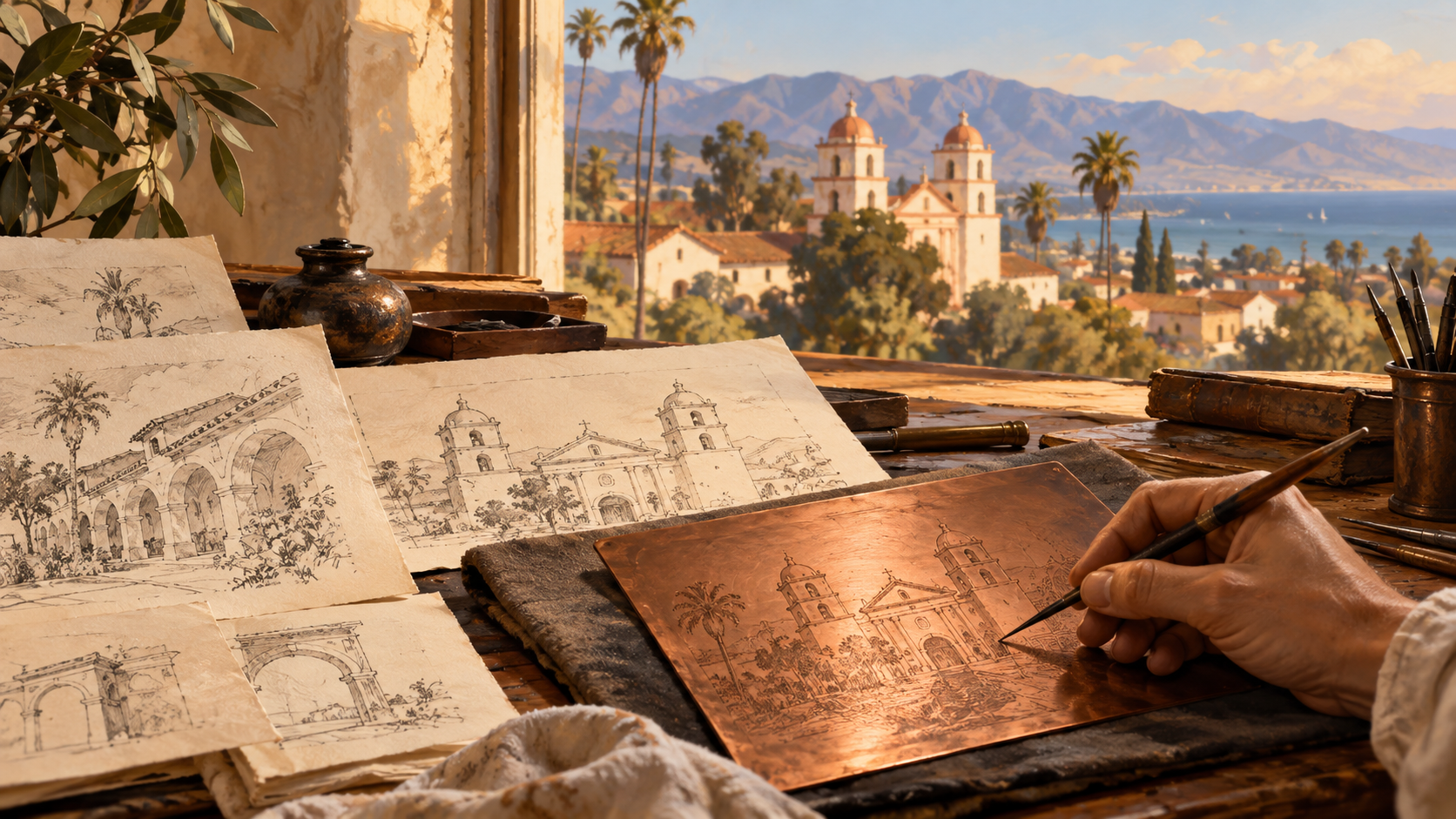
Visitors interested in this built history should use the Trust’s School of the Arts history and Presidio Research Center information as starting points, rather than treating an imagined picture of the past as a wayfinding map. The artwork in this article is deliberately conceptual. It conveys the energy of paint, paper, and printmaking without pretending to recreate a verified room or exact view.
Architecture and art education meet in a useful question: what does a place make possible? A theater allows rehearsal and audience; a studio gives light and working space; a classroom supports repetition and exchange. The Trust’s preservation account lets us ask that question about real surviving structures, even though it does not supply a full day-by-day history of their use.
What an alumnus’s oral history adds 🎙️
Institutions often preserve their official milestones better than the texture of student life. The Trust’s digital collection entry for Campbell Grant helps balance that. Its catalog says Grant won a scholarship to the school in 1930 and later worked with the Federal Arts Program and Disney. The collection also identifies audio clips about the school’s departments, its people, the Alhecama Theatre, his scholarship experience, and the Depression. The recorded interview is dated May 1, 1984.
An oral history is a particularly valuable kind of source, but it should be used with care. It preserves a participant’s perspective decades after the events described. The catalog confirms the topics and the interview’s existence; without transcribing and checking each audio segment, it would be wrong to put specific words in Grant’s mouth. Even at the catalog level, however, his account shows that the school was a lived experience, not just an entry in a timeline.
The scholarship detail matters. It points to a path into arts education for a person whose later career crossed several creative fields. It does not prove the school was universally accessible or tell us how many students received aid. It does show one documented case in which financial support and teaching intersected. The Trust’s historical overview also says the school offered local residents classes at little to no cost, reinforcing the public-facing character of its mission without supplying a complete fee schedule.
More than a painting school
The early mix of music, drama, photography, and fine arts described by the Historical Museum invites a different reading of the school’s name. “Arts” was plural for a reason. The boundaries between a stage production, a photograph, a drawing, and a designed object may have been more permeable than a modern category label suggests. The source does not describe every course or year, so the article should not invent a complete catalog. The documented range is still enough to challenge a narrow view of the institution.
Consider how a multidisciplinary setting can change an artist’s thinking. Theater teaches an eye for sequence and space. Photography sharpens questions of framing and light. Printmaking makes an image’s materials and repeatability visible. Painting and drawing develop observation, color, and composition. These are interpretive connections, not a claim that a particular teacher taught an integrated course. They make the school’s broad early curriculum meaningful to readers who practice more than one art form today.
The later focus on fine arts, as described by the Historical Museum, also deserves attention. A school can change its emphasis while remaining recognizably itself. That shift may have shaped what future archives preserved—paintings and teacher names can be easier to exhibit than a short-lived performance or an everyday lesson. A careful history therefore asks not only what survives, but what types of activity are less visible in the record.
The wider network around the school
The Santa Barbara Art Association’s history puts the school in a much larger story of artists seeking public exhibition space. It notes the 1930 opening of the Faulkner Memorial Gallery, later outdoor displays by a group of young artists in 1933, and the eventual establishment of the Santa Barbara Museum of Art in 1941. These organizations were not identical, and the source does not say the school directly caused each later development. But they reveal overlapping needs: instruction, working space, exhibition opportunities, and a public audience.
This is a useful way to understand cultural infrastructure. The classroom helps artists learn. The studio supports making. The gallery gives work a place to be encountered. The association helps artists organize. The museum preserves, interprets, and presents collections. A thriving arts scene depends on several kinds of space at once. When one is missing, artists often have to build another route to the public.
The school thus belongs to a larger local tradition of collective effort. The Association’s account emphasizes that artists themselves helped find and sustain places to show work. The school’s faculty and students were part of that environment, but the connection should be understood as a network rather than a simple chain of cause and effect. Santa Barbara’s artistic identity emerged from many people and institutions, not from one campus alone.
How to read the school’s legacy today ✨
A practical way to approach this history is to start with three kinds of evidence. First, read the Historical Museum’s arts-movement overview for the role it assigns the school and its teachers. Second, read the Trust’s preservation account for the physical sites affected by the earthquake and later reuse. Third, explore the Trust’s Campbell Grant oral-history catalog for a student-centered doorway into the story. Each source fills a different gap.
Look, too, for the questions the sources leave open. How did students move between disciplines? What kinds of work were shown in school exhibitions? How did access to classes change as funding changed? Which artists or students are missing from the short institutional summaries? Those are research questions, not facts to fill with imagination. They offer a more honest and lively way to engage local history than assuming every detail has already been settled.
For artists working now, the school offers a broader lesson. Community identity is made through teaching as well as through finished works. A landscape painter’s skill may be remembered in a canvas, but a student’s ability to see and make can become part of a much longer cultural inheritance. That is why classrooms, affordable instruction, and spaces for experimentation deserve attention in any account of a city’s arts scene.
The school also reminds us that cultural infrastructure can be fragile. Buildings can be damaged; funding can disappear; institutional names can change. Yet ideas and relationships may carry forward in other forms. This is not a claim of a direct lineage from every 1920s class to every current Santa Barbara program. It is a reason to look for the human and physical connections that keep art practice possible.
A short guide for curious readers 📍
If you want to pursue this story beyond a screen, begin with the organizations that hold the evidence, not with a claim that any particular historical classroom is freely open to visit. The Santa Barbara Historical Museum presents the school within its wider art-history interpretation. The Santa Barbara Trust for Historic Preservation explains the Alhecama-area buildings and Presidio Research Center. Their current visit pages are the right place to confirm access, programs, and hours before making plans.
For a visual companion, compare the school’s network with the site’s article on Henry Chapman Ford and the California missions. Ford belongs to an earlier chapter of the local art colony. The school shows a later chapter: the shift from individual arrival to organized instruction. The two stories are related but not interchangeable.
Finally, use the dates carefully. The sources agree on the school’s central importance, but their timelines do not align perfectly. Saying “founded in 1920” is supported by the Historical Museum; saying “opened in 1922” is supported by the Trust. The archive’s 1920–1938 span and the Trust’s 1932 endpoint describe different records. Keeping that nuance visible respects the history and the reader.
Frequently asked questions
When was the Santa Barbara School of the Arts founded?
The Santa Barbara Historical Museum says 1920. The Santa Barbara Trust for Historic Preservation says the school opened in 1922 as part of the Community Arts Association. Those sources may be referring to different institutional stages, but the published pages do not fully reconcile them.
When did the school close?
There is no single date consistently used across the sources consulted. The Trust says it survived until 1932 amid Depression-era funding loss. The Historical Museum describes seventeen years of teaching after a 1920 founding, while its archive authority record lists 1920–1938. This article does not choose one date as definitive.
What did students study?
The Historical Museum says the early curriculum included music, drama, photography, and more, and that the school later concentrated on fine-arts instruction. Its account specifically identifies John Marshall Gamble teaching advanced landscape painting and sketching from 1929.
Which artists taught there?
The Historical Museum’s Guiding Lights page names Carl Oscar Borg, Colin Campbell Cooper, John Marshall Gamble, and Fernand Lungren among teachers. It is a selected list, not a claim to identify every faculty member.
Did the 1925 earthquake affect the school?
Yes. The Trust for Historic Preservation says the original nearby home was destroyed and that the school subsequently built a new theater, painter’s studio, and temporary wooden structures.
Can I see a surviving school building?
The Trust says the former painter’s studio is now the Presidio Research Center and that some temporary structures still stand. Check the Trust’s current visitor information before planning any access; surviving does not automatically mean every space is open to the public.
Is the artwork in this article historical documentation?
No. The featured image is original conceptual editorial artwork made for this story. It evokes creative practice but does not reproduce a known school room, student, teacher, or artwork.
Keep exploring Santa Barbara art
The story of the school becomes richer beside earlier and later chapters. Read about Ford’s mission images and nineteenth-century Santa Barbara, then follow Colin Campbell Cooper’s Santa Barbara art history. For the underlying local records, visit the Santa Barbara Historical Museum and the Santa Barbara Trust for Historic Preservation. Their differing perspectives are part of what makes this history worth looking at closely.


Comments