


Alexander Harmer and the Studios That Helped Build Santa Barbara’s Art Colony

Santa Barbara’s reputation as an art city did not appear fully formed with a museum, a gallery district, or a familiar postcard view. It grew through working spaces and relationships. One of the most revealing places to begin is the studio complex associated with painter Alexander Francis Harmer and the Yorba–Abadie adobe. The Santa Barbara Art Association’s history dates Harmer’s complex to 1901 and describes artists and the public meeting there. The Santa Barbara Historical Museum’s 2015–16 annual report says he built four studios on the property, where artists including Edward Borein lived and worked.
Those two accounts invite a larger question: how does a private working place become a cultural institution before it has a formal name? Harmer’s story is not simply that of one painter producing images of an earlier California. It is also about architecture, family, publication, public encounter, and the way a cluster of studios can change what a city makes possible for artists. 🎨
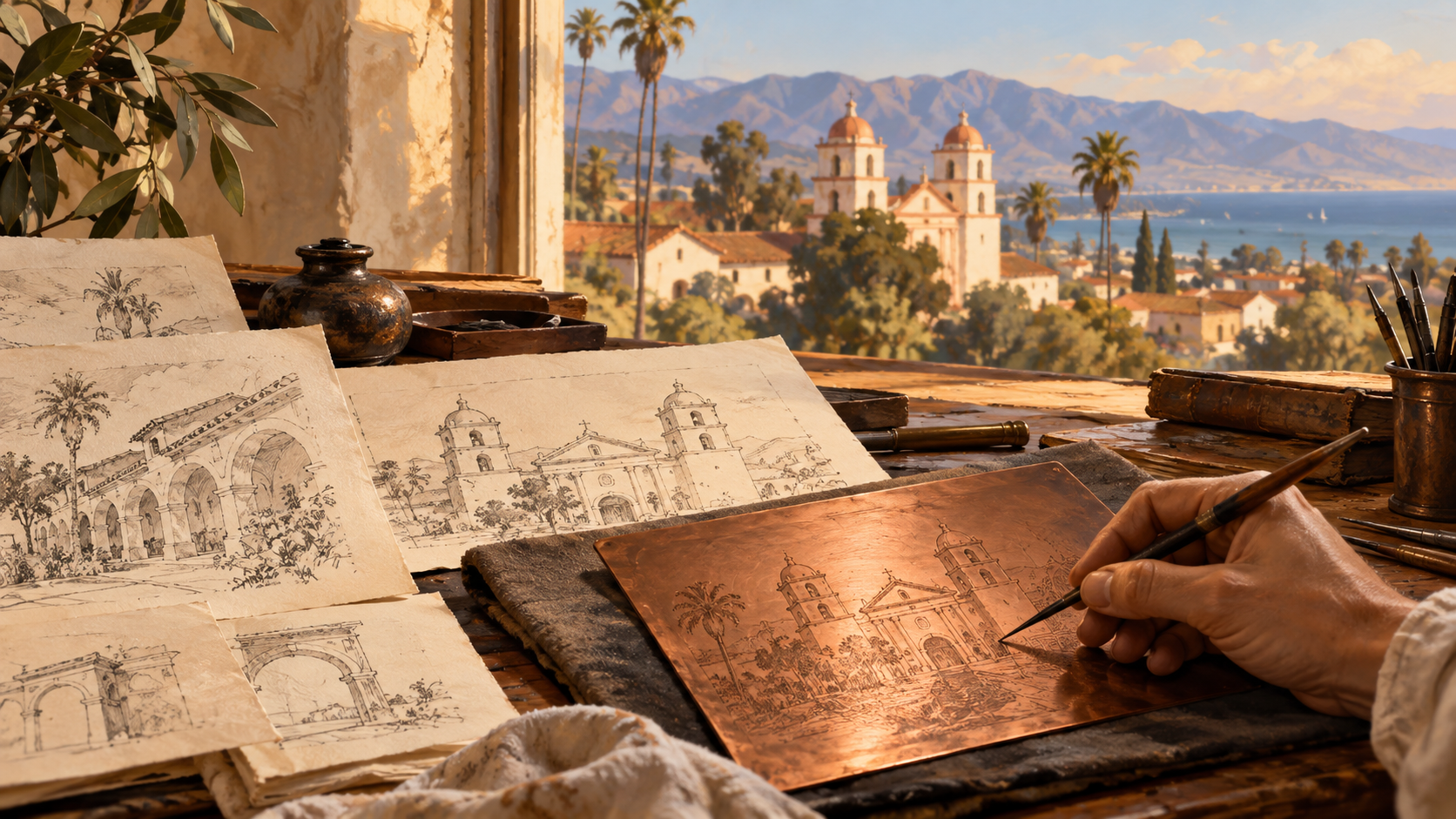
The image below is an original conceptual editorial illustration, not a reconstruction of Harmer’s actual home, studios, paintings, or Santa Barbara in 1901. It uses the vivid color of SantaBarbara.Art to suggest the energy of an artistic gathering without pretending to be historical documentation.

Original conceptual editorial illustration for SantaBarbara.Art. The imagined studio and landscape do not depict a known Harmer building or painting.
The artist before the art colony 🖌️
The Smithsonian Archives of American Art identifies Alexander Francis Harmer as a painter and illustrator who lived from 1856 to 1925. Its collection description places him in Santa Barbara and describes his work as paintings and illustrations of frontier life in Southern California. That archival framing matters: it points to an artist whose imagery traveled through more than one medium, rather than a painter known only through surviving canvases.
The Historical Museum’s annual report supplies another piece of the path. After studying at the Pennsylvania School of Fine Arts, Harmer joined the army and moved west. The report notes cavalry duty in Arizona and says an episode in 1881 helped produce the later label “Artist of the Apaches.” That historical label should be understood as a title used in accounts of his life, not as a neutral explanation of Indigenous peoples or a reason to treat his pictures as transparent records of their experience.
By the 1890s, the museum says, Harmer was in Santa Barbara. The Smithsonian’s collection summary records that he married Felicidad Abadie in 1893 and that they settled in her family residence, the Yorba–Abadie adobe. The museum’s account describes it as her birthplace. Rather than imagining Harmer as an artist who discovered an empty landscape, the records point to a marriage, an existing home, inherited family material, and local relationships that shaped the setting in which he worked.
This is a useful corrective to the solitary-genius version of art history. A studio needs a site; a painter needs materials, time, patrons, and people willing to look; an image’s meaning depends partly on whose memories and possessions are brought into it. Harmer’s Santa Barbara chapter becomes more interesting when the adobe and the people around it are treated as more than scenery.
Four studios and an unusual kind of public space 🏡
The Historical Museum says Harmer built four studios on the Yorba–Abadie grounds and calls the resulting cluster the first art colony along the West Coast. The Art Association gives 1901 for a complex of studios that encouraged interaction between artists and the public. These are institutional descriptions, not a surviving day-by-day guestbook. They establish the scale and social intention of the place without telling us what happened in every room on every afternoon.
Even with that limitation, the distinction between one studio and four is important. A lone workspace is organized around one practice. A small compound can host several artists, techniques, conversations, and audiences at once. The Association’s emphasis on contact with the public suggests that art was not kept entirely behind a closed door. The studio could be a place for production and a place where viewers learned what artistic production looked like.
The museum’s report specifically names Edward Borein among artists who lived and worked there. That is an important connection, but it should not flatten the two careers into one style or subject. Borein’s etched and drawn motion has its own story, explored in our article on Edward Borein in Santa Barbara. Harmer’s compound is the shared physical setting that lets us consider how distinct artists could inhabit one local creative network.
There is a broader lesson in the word “colony.” It is an art-historical label for a concentration of makers and studios, but it also carries other meanings in California history. Here it should not erase the Chumash presence or the Spanish and Mexican histories that preceded the studio complex. Nor does it mean that every artist in Santa Barbara worked under Harmer’s direction. It describes a particular gathering place within a much longer and more complicated local story.
What the adobe contributed to the work 🌴
According to the Smithsonian, the Yorba–Abadie residence became an artists’ colony under the Harmer family’s patronage. The Historical Museum’s account says Harmer posed Felicidad, their seven children, and members of her family in many pictures, using costumes and accessories passed down through her. That detail changes how we look at the paintings. The people and objects were not generic props floating in a romanticized past; they came through a particular household and its material inheritance.
At the same time, a costume in a painting does not make the painting a candid photograph. An artist chooses a pose, a setting, a viewpoint, and an arrangement of color. Family heirlooms can add historical texture while the resulting image remains a constructed interpretation. The most productive way to approach Harmer’s historical scenes is to ask both what material evidence he drew upon and what story he chose to tell with it.
The Historical Museum’s *De la Tierra* exhibition page offers helpful context for the built setting. It says Santa Barbara’s downtown at the turn of the twentieth century mixed Victorian, East Coast American, rural Western, and Mexican adobe architecture. Its account also notes that many adobe structures were later neglected, demolished, or lost. That means a painting or photograph of an adobe can now carry architectural evidence as well as artistic imagination—but the two forms of evidence must not be confused.
For a reader looking at Harmer today, the adobe is therefore a hinge between art and place. It was a family home, a studio site, and a visual subject within a changing town. It also reminds us that the familiar standardized Spanish Colonial and Mediterranean appearance of modern Santa Barbara was not the only look the city ever had. A historical artist’s image can make an earlier mixture visible, even while it asks us to examine the artist’s choices critically.
California history on canvas: memory and invention
The museum’s annual report says Harmer’s focus shifted toward reviving images of early Alta California. It also identifies contemporary subjects in his work, including a Flower Festival, a visit by former Governor Pacheco, and a 1908 celebration prompted by the Great White Fleet’s visit. These examples show an artist moving between historical imagination and events closer to his own lifetime. A single label such as “mission painter” would miss that range.
Harmer’s scenes can be engaging precisely because they organize a world. Clothes, gestures, architecture, and gatherings offer viewers an entry point into an imagined past. But the same strength demands careful interpretation. Which lives are centered? Which labor is visible? What gets made festive, heroic, or picturesque? A painting might tell us a great deal about the period it portrays, the period in which it was painted, or both; it should not be asked to stand alone as a complete social history.
The Smithsonian archive description helps widen the lens beyond individual pictures. It lists correspondence, photographs, possible studio photographs, copyright registrations, and periodicals containing Harmer illustrations. Among the periodicals named are *The Land of Sunshine*, *Overland Monthly*, and *The Californian*. Those records show that his work circulated through print culture, where an illustration could reach readers far from Santa Barbara. The archive describes what it holds; it does not by itself establish how each reader interpreted an image.
Harmer’s practice thus joined three spaces: a local studio, a household with historical objects and stories, and a publishing world that distributed images. That combination helps explain why his significance is larger than a list of paintings. The studio created encounters in Santa Barbara; the magazine page carried representations of California outward; the archive now lets researchers compare both.
A neighbor to other Santa Barbara art histories 🖼️
Harmer was not the first major artist drawn to the South Coast. The Historical Museum’s arts-movement overview names Henry Chapman Ford as the first major artist to settle here, in 1875, and places Harmer among later figures in the growing art colony. Our Ford article explores an earlier artist’s mission imagery. Reading Ford and Harmer together is more revealing than treating them as interchangeable painters of old California: one story emphasizes a pioneering arrival and a broad mission series; the other highlights a household-based studio complex and its social life.
The chronology continues beyond Harmer. The Art Association places the Santa Barbara School of the Arts and the Santa Barbara Art Guild in the 1920s, followed by the Faulkner Memorial Gallery’s opening in 1930. Its history explains that artists needed places to exhibit and that finding and funding those places was difficult. Harmer’s studios were not a direct cause of every later institution. They were an earlier example of the same recurring problem: artists need physical and social infrastructure, not only inspiration.
That distinction matters because Santa Barbara’s cultural landscape is often described as if its galleries naturally grew out of the scenery. The Association’s account says otherwise. People organized, donated land and money, petitioned, formed groups, and maintained exhibition opportunities. Harmer’s complex belongs in that history of deliberate creation. If the studios made interaction possible, later galleries and associations gave those interactions more durable public forms.
Our recent story on the Santa Barbara School of the Arts follows a later institutional chapter. Harmer’s earlier compound and the school are connected through the question of shared artistic space, but they are not the same organization. Keeping them separate makes both stories clearer: a small group of studios can incubate encounters; a school can organize teaching; a gallery can provide exhibition; an association can advocate for artists.
What the archive can—and cannot—tell us 🔎
The Smithsonian’s finding aid is valuable because it tells researchers what kinds of evidence survive. Letters to Harmer, reproductions of artworks, photographs, printed material, and later Harmer Trust records make possible questions that a short biography cannot answer. A letter might illuminate a professional connection; a periodical might show how an image was framed for its audience; a photograph might help locate or understand a workspace. These are research possibilities, not findings asserted without inspecting the individual items.
The Trust records, which the Smithsonian dates to 1954–1985, also remind us that an artistic legacy continues to be shaped after the artist dies. Inventories, conservation records, minutes, and correspondence document choices about what is preserved and how. A museum exhibition and an archive catalog are themselves acts of interpretation. They help the public see a career, but they are not substitutes for the full range of surviving works and documents.
There are also limits to the sources used for this article. The museum annual report summarizes an exhibition; the Association’s history tells a long institutional story; the archive lists holdings and a biography. They agree on Harmer’s importance but do not provide a complete architectural plan of the four studios or an inventory of every person who worked there. Rather than fill those gaps with a lively fictional scene, this article leaves the unknowns visible.
That is why the cover image is explicitly conceptual. It is possible to make an expressive illustration about studio culture without claiming that a particular arch, window, vase, or hillside appeared in Harmer’s compound. The distinction protects readers from a subtle but common error: confusing a compelling visual mood with historical proof.
How to look at Harmer’s legacy today ✨
Start with the space. Ask what it meant for several artists to work near one another at the Yorba–Abadie adobe, and why the Art Association remembered contact with the public. Then look at the images. Notice who is present, which materials signal a particular past, and whether a work depicts a remembered event, a staged historical scene, or something contemporary to Harmer. Finally, look at the records around the pictures: publication, family history, exhibition interpretation, and preservation.
This approach avoids two easy extremes. Harmer need not be treated as a perfect documentary witness to early California; nor should his art be dismissed because it is composed and selective. Its value lies partly in the questions it raises about memory, representation, and Santa Barbara’s making of cultural identity. The same close looking applies to any historical artwork whose beauty can make its choices seem invisible.
If you want to go deeper, the Historical Museum’s writing on its arts movement and art of the adobe offers local context, while the Smithsonian finding aid identifies archival materials. Check current museum programs and access information before planning a visit; this article does not assume a past exhibition is currently on view or that archival materials are available without arrangements.
Harmer’s legacy is therefore not only a painter’s biography. It is a story about a household becoming a creative address, about images traveling through magazines, about later institutions recognizing a studio complex as part of the city’s art history, and about the public’s continuing responsibility to look at historical scenes with curiosity and care.
Frequently asked questions
Who was Alexander Francis Harmer?
The Smithsonian Archives of American Art identifies him as a painter and illustrator, 1856–1925, associated with Santa Barbara and images of frontier life in Southern California.
Why are Harmer’s studios important to Santa Barbara art history?
The Santa Barbara Art Association dates a studio complex to 1901 and says it encouraged interaction between artists and the public. The Historical Museum reports four studios on the Yorba–Abadie property and says artists including Edward Borein lived and worked there.
Was the Yorba–Abadie adobe simply an artist’s studio?
No. The Smithsonian describes it as the Abadie family residence in which Harmer and Felicidad Abadie settled after their marriage. The museum’s account also connects family members and inherited costumes and accessories to his pictures.
Did Harmer paint only historical subjects?
No. The Historical Museum’s annual report discusses his early-California imagery and also names contemporary gatherings and events among his subjects.
Are Harmer’s paintings documentary evidence?
They can be evidence of an artist’s choices, materials, and ways of imagining California, but a composed painting should not be treated as an unfiltered record of every person or event it shows.
Is the cover image a real Harmer studio or artwork?
No. It is original conceptual editorial art created for this article, not a reconstruction or photograph of Harmer’s studio, house, painting, or any historical event.
Keep exploring Santa Barbara art
Follow the earlier chapter in Henry Chapman Ford’s mission images, the shared-studio connection in Edward Borein’s Santa Barbara story, and the later teaching network in the Santa Barbara School of the Arts.


Comments