


Chumash Basketry Is Living Art: A Guide to Santa Barbara’s Exhibition

A basket can be a vessel, a record of skilled hands, and a relationship with the land that supplied its materials. At the Santa Barbara Museum of Natural History, Chumash Basketry: Art & Life invites visitors to consider all three. The exhibition places work by weavers past and present in the same story, making a crucial point: Chumash basketry is a living practice, not an art form sealed in the past. 🌿
The exhibition is on view in its current space through November 30, 2026. The museum says a lightly updated version will reopen in Fleischmann Auditorium on December 21, 2026. It is included with regular museum admission. Check the museum's exhibition page before visiting for the latest presentation details.
For Santa Barbara readers, this is an opportunity to look more carefully at an art form rooted in this region and sustained by contemporary makers. It is also a chance to ask better questions. What can the choice of a plant tell us about knowledge and stewardship? What does it mean to view a functional object as art? And whose voices should guide the interpretation of objects held by a museum?

The artwork above is an original AI-assisted editorial illustration of plant materials and an imagined coastal atmosphere. It does not depict an actual Chumash basket, artist's work, exhibition installation, or documented location.
Begin with the makers, not the display case 🧺
The museum describes the exhibition as a meeting of baskets by earlier and contemporary Chumash weavers. That framing changes how a visitor might enter the room. A historical basket is evidence of extraordinary skill and knowledge, but it does not mean the knowledge ended when the object entered a collection. The institution explicitly says modern Chumash weavers continue making baskets by hand, teaching younger generations, and working with the native plants that make the practice possible.
The museum has also identified contemporary weavers whose work is featured in the exhibition. In its account of a 2025 visit by a Vatican Museums curator, it names Susanne Hammel-Sawyer, Samantha Sandoval, and Ernestine Ygnacio-De Soto. Their presence makes it impossible to tell this story only in the past tense. Visitors should look for the names of individual makers on object labels and resist the common habit of treating an Indigenous art form as anonymous. The museum's account of the visit also describes the baskets as being shown with the voices and faces of their makers.
That distinction matters beyond this one gallery. A label that says merely “Chumash basket” can identify a broad tradition while hiding the person who made a particular work. Where a maker is known, a name changes the encounter. It asks us to see an individual artist's decisions—about material, shape, rhythm, proportion, and purpose—inside a shared cultural practice.
What a basket can do
The museum's educational material lists a remarkable range of uses for baskets in Chumash life: gathering, storing, preparing, and serving food; holding water and valuables; measuring acorns for trade; carrying babies; gaming; gifts; and ceremony. These were not interchangeable containers. Different purposes required different structures and materials. The museum's Chumash daily-life resource explains that weavers used both coiled and twined techniques.
Think about what that range asks of a maker. A basket meant to hold water raises different technical questions from one meant to sift or carry. A tightly coiled form depends on the accuracy and consistency of every stitch. A larger object has to maintain its structure across many hours of work. Function is not the opposite of artistry here; it is one of the challenges artistry answers.
The museum describes coiled baskets with a foundation of slender juncus rush rods, bound with split strands of the same material. It also describes twined forms, including sieves, fish traps, cradles, and bottles. These details are worth reading in the gallery because they help a visitor notice that a basket's surface is a record of decisions. What looks like a continuous shape was built through repeated, exact actions.
Some vessels could hold water. According to the museum, certain coiled baskets were woven tightly enough for that purpose, while some twined bottles were sealed inside with asphaltum. One need not romanticize this as a lost secret or turn the visit into a craft lesson. The important point is that knowledge of material behavior—how fibers bend, tighten, dry, or seal—was embedded in the work.
Plant knowledge is part of the art 🌱
The exhibition asks visitors to recognize the plants that make basketry possible. That is more than a botanical sidebar. The museum says present-day Chumash weavers use specific native plants that must be managed, harvested, and prepared. A finished basket can therefore be understood as the visible end of a much longer process involving habitat, timing, care, and transmission of knowledge.
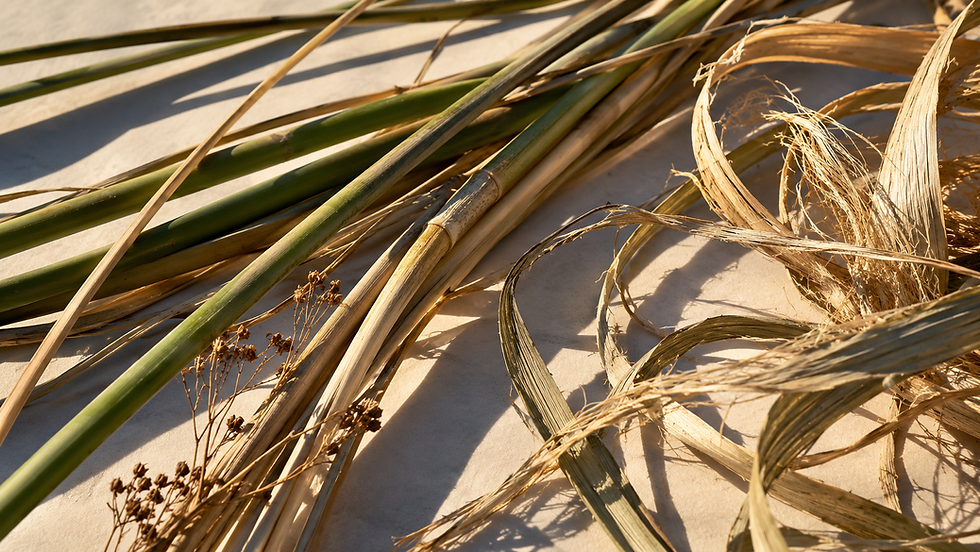
Original AI-assisted editorial study of plant material, not a documentary photograph or a depiction of Chumash artwork.
In its story “A Chumash Basket Returns to Chumash Land”, the museum discusses how local wetland loss has made juncus plants harder to sustain for contemporary weavers. It also describes the Sukinanik’oy Garden of Chumash Plants on the museum grounds, where plant knowledge has a living presence. The garden's name, selected by Ernestine Ygnacio-De Soto's family, means “bringing back to life” in Barbareño Chumash, according to the museum.
That connection between ecology and cultural practice gives the exhibition a specifically local urgency. A visitor may be accustomed to seeing habitat conservation and art history as separate concerns. Basketry shows how closely they can meet. If a plant becomes scarce, access to a material and to the knowledge surrounding it changes. If that knowledge is taught and the plant is cared for, making remains possible.
The point is not that visitors should gather reeds themselves. Wild materials may be protected or culturally significant, and taking them can damage habitat or interfere with community use. The better response is to notice the relationship between a maker and a place, then support the people and stewardship practices that sustain it.
Look closely without claiming to know everything
An effective visit can begin with ordinary visual questions. How does a form widen or narrow? Where does a repeated line change direction? Does the surface look dense or open? How does the object suggest its function? Read the label, then look again. The information can change what you see.
At the same time, a visitor should be careful about assigning meanings to a design or material without evidence. A geometric arrangement may look familiar, but a viewer's guess is not the maker's account. Ask whether the museum provides a named maker, community attribution, date, material, and explanation. If it does not, leave the uncertainty intact rather than inventing a story.
This approach can make the exhibition more rewarding than a quick search for the most visually intricate object. A modest-looking vessel may reveal an ingenious solution to a practical need. A contemporary work may speak to continuity, experimentation, or teaching. An older object may carry the evidence of a maker whose name was not preserved in the record. Each calls for a different kind of attention.
The museum holds what it calls the world's largest collection of Chumash baskets. That gives its interpretation unusual importance. Collections can preserve fragile objects and make close study possible, but a museum does not own the living practice behind them. The work of contemporary weavers and Chumash communities should remain central to how the objects are understood.
Continuity, interruption, and renewal
It would be misleading to describe Chumash basketry as an unbroken, easy line from past to present. Colonial violence, displacement, environmental change, and collecting practices altered the conditions under which people could make and transmit baskets. Yet it would be equally misleading to describe the art as extinct. The museum's exhibition explicitly centers contemporary makers.
The museum's history of one basket returning to Chumash land offers a concrete example of renewal. It recounts how California Arts Council artist-in-residence Patricia Anna Campbell worked with a basketweaving group at the museum in the 1980s. Ernestine Ygnacio-De Soto and curator Jan Timbrook learned from that work and from studying baskets in the collection. The group continued gathering and weaving over subsequent decades. The museum also notes that Ygnacio-De Soto's niece, Samantha Sandoval, learned to weave in the Chumash style in 2012.
Those details make “revival” less abstract. They point to actual people, meetings, study, teaching, and time. A museum collection can be a resource, but continuity is made by people who choose to work with it, question it, and carry knowledge forward on their own terms. This is why the exhibition's pairing of past and present is more meaningful than a simple timeline of old objects.
The Santa Ynez Chumash Museum and Cultural Center is another place to hear Chumash history and culture presented by a Chumash institution. Its emphasis on past, present, and future is a useful reminder that no single museum display can contain the whole story. The Santa Barbara exhibition can be a beginning, not the final authority.
The tomol broadens the conversation 🌊
The basketry exhibition shares space with other displays, including a historic Chumash plank canoe, or tomol. The museum says Fernando Librado Kitsepawit remembered seeing the last original tomols as a boy in the 1850s. In 1915, he shared his knowledge with anthropologist John P. Harrington as they built a tomol for display. The museum notes that this knowledge later helped new tomols cross the Santa Barbara Channel.
The tomol is not a basket, and the practices should not be collapsed into one. Its presence does, however, widen the visitor's sense of material intelligence in this region. In both cases, the object is more than a static artifact: it holds knowledge about materials, construction, use, place, and the people who carried that knowledge.
This is also a useful moment to think about the limits of a display case. A canoe is made to move; many baskets were made to work in daily life. Museum presentation can reveal shape and technique, but it cannot reproduce every relationship those objects once had. The exhibition is most valuable when it points visitors outward—to living makers, landscapes, and community knowledge.
A thoughtful way to visit
Give yourself time to move between the historical and contemporary work rather than treating one as an introduction to the other. Read maker names first. Notice which labels explain materials and which leave open questions. If the exhibition includes a living weaver's own words, give those words priority over a quick visual impression.
A useful three-pass approach is simple:
First pass: form. Look at shape, scale, and construction before reading every label. Record what you actually observe rather than what you assume.
Second pass: context. Read the maker, material, date, and interpretive information. Notice how the story changes when a named person or specific plant enters it.
Third pass: connection. Return to one work and ask what it reveals about function, ecology, skill, or cultural continuity. Let a question remain unanswered if the display does not answer it.
Families can do this without turning the visit into a quiz. A child might notice a curve, a repeated line, or the difference between an open and a tightly worked surface. Adults can help by asking “What do you see?” before “What does it mean?” The goal is careful looking and respect, not a claim to expertise after one afternoon.
If you want to extend the visit into an art-focused day, the SantaBarbara.Art guide to Santa Barbara's Arts & Crafts Show offers another way to meet makers and think about the relationship between materials, skill, and place. Our coastal cyanotype guide approaches local plants from a different, contemporary creative practice, with an emphasis on leaving natural materials where they belong. These are related ways of looking, not substitutes for Chumash basketry or Chumash teaching.
Plan your visit 📍
The exhibition is at the Santa Barbara Museum of Natural History, 2559 Puesta del Sol, Santa Barbara, CA 93105—the museum campus, not the Sea Center on Stearns Wharf. The museum currently lists daily hours of 10 a.m.–5 p.m., with special hours and closures that visitors should check before leaving home. As of October 14, 2026, regular museum admission is $20 for adults ages 18–64, $17 for seniors and teens, and $15 for children ages 2–12; children under two and members enter free. The museum lists $5 admission through Museums for All for eligible SNAP/CalFresh visitors with an EBT card and photo ID, for up to four people. Check its current hours and admission page for changes.
The basketry exhibition is included with museum admission. The museum states that the exhibition space is ADA accessible. Its accessibility page describes accessible routes, parking, restrooms, and a downloadable map; it also notes that some other museum spaces are exceptions to general wheelchair access. Visitors with specific access needs can contact the museum before the trip. The locations page lists free parking in the museum lot.
Remember the presentation changes after November 30. The museum says a lightly updated version reopens December 21 in Fleischmann Auditorium. Check the exhibition page before planning a visit during the interval. If you photograph for personal use, consult museum rules; the institution says commercial or publication photography requires contacting it in advance.
Why this exhibition matters
Chumash Basketry: Art & Life offers an unusually direct way to see the meeting of artistic form, practical knowledge, native plants, and living cultural work. Its strongest lesson may be a change in tense. The baskets in a collection were made by people whose skill deserves close attention. Baskets being made now also belong to this story, and the makers should be visible within it.
For an art publication in Santa Barbara, that is a meaningful local subject. The exhibition encourages us to attend to individual artists, to the material environment that supports their work, and to the limits of what a display case alone can explain. Visit with curiosity, read the names, follow the sources, and let the makers—not a generic idea of “tradition”—lead the way.
Frequently asked questions
Is Chumash Basketry: Art & Life still open in 2026?
Yes. The museum says it remains in its current exhibition space through November 30, 2026. A lightly updated presentation is scheduled to reopen in Fleischmann Auditorium on December 21, 2026. Check the official exhibition page for the latest status.
Is there a separate ticket for the exhibition?
The museum says the exhibition is included with regular museum admission. Admission categories and prices can change, so check the official hours and admission page before visiting.
Does the exhibition include work by living Chumash weavers?
Yes. The museum describes work by weavers past and present. Its reporting names Susanne Hammel-Sawyer, Samantha Sandoval, and Ernestine Ygnacio-De Soto among the contemporary weavers featured.
Why do the plants matter?
The museum explains that basketmaking depends on particular native plants and on knowledge of how to manage, gather, and prepare them. Looking at materials helps visitors understand a basket as the outcome of environmental care and skilled making, not just an attractive pattern.
Is the exhibition accessible to wheelchair users?
The museum identifies the exhibition space as ADA accessible. Its accessibility page gives more detail about routes, parking, and restrooms, and lists exceptions elsewhere on the campus. Contact the museum for questions specific to your visit.
Can I photograph the baskets?
The museum says photography and filming are allowed for personal use, while commercial or publication use requires contacting the institution. Follow any object-specific signs or staff guidance in the exhibition.
Where else can I learn about Chumash culture?
Start with the Santa Ynez Chumash Museum and Cultural Center, a Chumash institution that presents its own history and contemporary culture. The Santa Barbara Museum of Natural History also provides public educational resources linked above. Neither a short article nor one exhibition can replace the voices of Chumash communities.


Comments