


🌌 The New Star Wars Museum Is Almost Here: Inside the Lucas Museum of Narrative Art Opening in Los Angeles

Updated: Sep 4
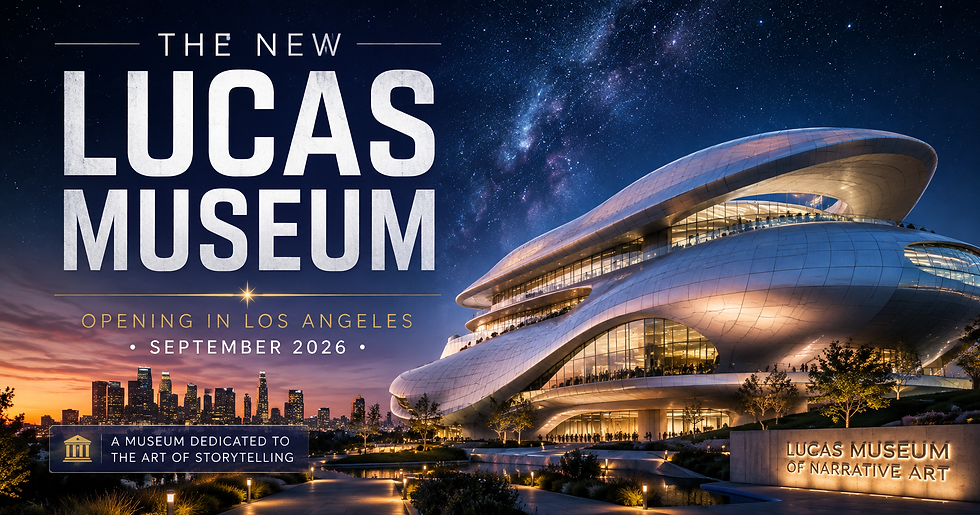
Meta Description: The Lucas Museum of Narrative Art opens September 22, 2026, in Los Angeles. Discover its Star Wars collection, incredible architecture, galleries, ticket prices, exhibits, and why California artists should visit.
Los Angeles is about to welcome one of the most exciting new museums in California—and for Star Wars fans, artists, filmmakers, photographers, and lovers of visual storytelling, this one is going to be special. 🚀✨
On September 22, 2026, the long-awaited Lucas Museum of Narrative Art will officially open its doors in Los Angeles.
Founded by legendary filmmaker George Lucas and business leader and philanthropist Mellody Hobson, the museum is much more than a place to see Star Wars memorabilia.
It's an enormous celebration of visual storytelling.
Inside, visitors will encounter everything from paintings, illustration, photography, comic books, manga, and children's book art to cinematic concept art, costumes, props, fantasy artwork, and artifacts from the world of Star Wars.
For California's creative community, the opening represents something even bigger.
The Lucas Museum asks us to reconsider what art can be—and how pictures have been telling human stories for generations.
And for those of us in Santa Barbara, it's close enough for an incredible Southern California art road trip. 🌴🚗
Let's take a look inside one of America's most anticipated new museums.
⭐ What Is the Lucas Museum of Narrative Art?
The Lucas Museum of Narrative Art is a massive new cultural institution founded by George Lucas and Mellody Hobson.
Its central idea is surprisingly simple:
Images tell stories.
Long before movies, television, Instagram, animation, or digital art existed, human beings communicated through pictures.
Ancient civilizations created visual stories.
Painters depicted legends and historical events.
Illustrators brought books to life.
Photographers captured moments that changed history.
Comic artists created entire universes with ink and paper.
Filmmakers eventually combined imagery, movement, sound, costume, architecture, music, and performance into one of humanity's most powerful storytelling mediums.
The Lucas Museum is dedicated to exploring this enormous tradition of narrative art. 🎨
The museum's collection contains more than 40,000 works, spanning an extraordinary range of visual storytelling.
More than 1,200 objects are expected to appear throughout the inaugural exhibitions across more than 30 galleries.
Visitors will encounter artwork connected to:
🎨 Illustration
📚 Children's books
🦸 Comics and graphic stories
🇯🇵 Manga
📸 Photography
🎬 Cinema
🚀 Science fiction
🐉 Fantasy
❤️ Romance
🤠 Western stories
🏛️ History
🖌️ Murals
👨👩👧 Family life
🏀 Sports
🏫 Childhood and school
🌎 Community
Rather than creating a museum that separates traditional fine art from popular culture, the Lucas Museum celebrates something George Lucas has called "the people's art."
That philosophy could make this museum very different from the traditional museum experience.
🚀 Yes, There Will Be Star Wars
Let's answer the question many people are probably wondering:
Will there actually be Star Wars memorabilia inside?
Yes.
One of the inaugural museum installations is called:
⭐ Star Wars in Motion
The exhibition explores movement and transportation throughout the original six Star Wars films created under George Lucas.
Visitors will encounter a selection of:
🚀 Vehicle designs
🎨 Original illustrations
🎭 Costumes
🎬 Movie props
🏎️ High-speed racers
🛸 Flying vessels
🚙 Fantasy transportation designs
Announced objects include Luke Skywalker's Landspeeder from Star Wars: Episode IV – A New Hope and the first physical build of General Grievous's Wheel Bike from Star Wars: Episode III – Revenge of the Sith.
For Star Wars fans, seeing these objects in person could be unforgettable.
But for artists and designers, there's another reason the exhibition is so interesting.
It provides an opportunity to examine the creative process behind building an imaginary world.
🎨 Before Star Wars Was a Movie, It Was Art
One of the fascinating things about filmmaking is that imaginary worlds often exist on paper before they ever appear on a movie screen.
Someone has to imagine:
What does the spaceship look like?
What does the city look like?
What clothing do the characters wear?
What kind of vehicles exist?
What does an alien planet feel like?
What does the villain look like?
Before filmmakers can build these things, artists frequently have to visualize them.
That makes concept art one of the most important—and sometimes underappreciated—parts of filmmaking.
The Lucas Museum's archives contain an extraordinary collection of production artwork associated with the Star Wars universe.
Artists represented in the archive include legendary names such as Ralph McQuarrie, Joe Johnston, and Doug Chiang.
The archive includes conceptual imagery depicting subjects such as:
✨ C-3PO and R2-D2
⚔️ Luke Skywalker battling Darth Vader
🌌 The Death Star trench
🏜️ Mos Eisley
🚀 The Millennium Falcon
👽 Tusken Raiders
🌊 Otoh Gunga
Many of these images helped transform ideas into the cinematic universe audiences eventually saw on screen.
For today's digital artists, game designers, 3D artists, illustrators, and AI-assisted creators, this
process provides an important reminder:
Great imaginary worlds begin with visual ideas.
Modern artists might use Photoshop, Blender, Unreal Engine, Procreate, AI tools, or sophisticated 3D software.
The tools have changed dramatically.
The creative question hasn't:
How do you turn something that exists in your imagination into something other people can see?
🤖 The Incredible Lucas Archives
The Lucas Museum will become the permanent home of an extraordinary archive connected to George Lucas's filmmaking career.
The Lucas Archives trace their origins to 1983, when production wrapped on Star Wars: Episode VI – Return of the Jedi.
Over the decades, the archive expanded to preserve production material from numerous Lucasfilm projects.
The collection now includes materials connected to the first six Star Wars movies as well as the first four Indiana Jones films and other productions including:
🎥 Willow
🎥 Red Tails
🎥 Howard the Duck
🎥 Radioland Murders
And more. The archive contains items such as:
• Original artwork
• Concept drawings
• Production designs• Models
• Props• Costumes• Vehicles
• Maquettes
• Blueprints
• Filmmaking artifacts
For decades, much of this material functioned primarily as a production archive.
Now it has a permanent museum home.
That transformation is important.
Objects originally created to make movies are being recognized as artifacts of visual culture.
🏛️ The Building Looks Like Something From Another World
Even before visitors enter the galleries, they'll encounter a work of art.
The Lucas Museum building itself is extraordinary.
Designed by architect Ma Yansong, founder of MAD Architects, the museum has an organic, futuristic appearance that seems perfectly suited to a project associated with George Lucas.
Depending on your perspective, the enormous structure can resemble:
🛸 A spacecraft
☁️ A floating cloud
🌊 A smooth geological formation
🚀 A futuristic city
🎨 An enormous sculpture
Rather than constructing a conventional rectangular museum, the architects created a flowing sculptural building that appears to hover over portions of the surrounding landscape.
The result feels simultaneously architectural and cinematic.
It's the kind of building that could become a Los Angeles landmark in its own right.
📐 Just How Big Is the Lucas Museum?
The scale is impressive.
The museum building encompasses approximately:
🏛️ 300,000 Square Feet
Inside the five-story structure are approximately:
🖼️ 100,000 Square Feet of Gallery Space
The museum campus itself covers roughly:
🌳 11 Acres
And those acres aren't simply occupied by buildings and parking lots.
The surrounding landscape has been designed as an important part of the visitor experience.
More than 200 new trees, along with native and drought-tolerant landscaping, paths, meadows, and gathering spaces, help transform the site into a major public landscape.
The museum campus brings together:
🌳 Nature
🎨 Art
🏙️ Architecture
👨👩👧👦 Community
🚶 Public space
That makes the Lucas Museum much more than a place where visitors simply walk through galleries and leave. The goal is to create a destination.
🌿 Art Meets Landscape
The landscape surrounding the museum was designed by Mia Lehrer and Studio-MLA.
Rather than treating landscaping as decoration around the building, the museum incorporates gardens and outdoor environments directly into its identity.
Visitors will find landscaped areas designed for walking, gathering, relaxing, and experiencing the architecture from different perspectives.
Sustainability also plays an important role.
The campus incorporates features including:
☀️ Rooftop solar panels
💧 Rainwater capture for irrigation
🌱 Native and drought-tolerant plantings
🌳 Extensive tree coverage
💦 A fountain system contributing to renewable cooling
It's an interesting philosophy:
A museum about humanity's stories sits within a landscape designed to evolve naturally over time.
🖼️ More Than 30 Galleries of Storytelling
One of the biggest misconceptions about the Lucas Museum is that it will primarily display Star Wars memorabilia.
It won't.
The Star Wars material will undoubtedly attract enormous attention, but the museum's broader collection is arguably even more fascinating.
The inaugural exhibitions span more than 30 galleries and approximately 100,000 square feet of exhibition space.
Instead of organizing everything exclusively around traditional art-history categories, many galleries explore universal themes.
Visitors may move through stories involving:
❤️ Love
👨👩👧 Family
🏘️ Community
👶 Childhood
🏫 School
⚽ Sports
💼 Work
🎮 Play
🗺️ Adventure
✨ Fantasy
💘 Romance
🚀 Science fiction
This approach asks visitors to think about art differently.
Instead of beginning with:
"Who painted this?"
The museum encourages another question:
"What story is this image telling?"
That's an incredibly powerful way to introduce people to art.
🎨 Norman Rockwell and the Art of Everyday Life
One of the major strengths of the museum's collection is its significant holdings of work by Norman Rockwell.
Rockwell became one of America's most recognizable illustrators by depicting ordinary life with extraordinary storytelling ability.
A single Rockwell image could communicate an entire scene.
You could almost imagine what happened immediately before the picture—and what might happen afterward.
That's narrative art.
And it demonstrates why illustration deserves serious artistic consideration.
The Lucas Museum's collection extends far beyond Rockwell, including works associated with artists such as:
🎨 N.C. Wyeth
🎨 Jessie Willcox Smith
🎨 Maxfield Parrish
🎨 Kadir Nelson
🎨 Diego Rivera
🎨 Judith F. Baca
🎨 Jacob Lawrence
🎨 Charles White
🎨 Frida Kahlo
…and many more.
Visitors who arrive primarily because they love Star Wars may leave having discovered entirely different artists.
And that may be one of the museum's greatest strengths.
🦸 Comic Books Finally Get the Museum Treatment
Comic art is another major component of the collection.
For much of modern history, comics were treated as disposable entertainment rather than serious visual art.
That attitude has changed dramatically.
Today, original comic artwork can be studied for its:
✏️ Draftsmanship
🎨 Composition
📖 Sequential storytelling
🎭 Character design
💥 Visual movement
🧠 Narrative structure
The Lucas Museum has deep holdings of American and European comic art.
Artists represented include names such as:
Jack Kirby
Frank Miller
Jim Lee
Alison Bechdel
Marie Severin
Mœbius
…and others.
There's also a gallery dedicated to manga, recognizing the enormous influence of Japanese illustration and animation on global visual culture.
For younger artists raised on comics, anime, video games, and graphic novels, this could be one of the museum's most exciting areas.
🐉 Fantasy and Science Fiction Become Fine Art
Fantasy illustration occupies a fascinating position in art history.
Millions of people know these images from:
📚 Book covers
🎲 Games
🧙 Fantasy novels
🛸 Science-fiction stories
🎬 Movies
🎮 Video games
Yet the artists who created them haven't always received the same institutional recognition as traditional painters.
The Lucas Museum intends to give this kind of work a major platform. Its narrative galleries include fantasy and science-fiction artwork by artists including Frank Frazetta, Boris Vallejo, Julie Bell, Ken Kelly, John C. Berkey, and others. For digital artists working today, this history is incredibly relevant. Much of today's concept art, game art, digital illustration, fantasy imagery, and cinematic design descends directly from traditions established by these artists. Today's digital creators are building on a visual language developed across generations.
📸 Photography as Storytelling
Photography will also have an important presence inside the museum.
The collection includes documentary imagery by influential photographers such as:
📷 Dorothea Lange
📷 Gordon Parks
📷 Robert Capa
📷 Alfred Eisenstaedt
Photography may be one of the purest forms of narrative art. A photograph captures only a fraction of a second. Yet a powerful image can communicate an entire human experience.
War.
Migration.
Joy.
Poverty.
Family.
Protest.
Community.
History.
A photograph doesn't need hundreds of pages to tell a story.
Sometimes one frame is enough.
🎥 Two State-of-the-Art Theaters
Because cinema is central to George Lucas's creative legacy, it shouldn't be surprising that the museum includes spaces dedicated to film.
The building features two state-of-the-art cinematic theaters.
General admission includes access to the museum's theaters along with its galleries and exhibitions.
This creates fascinating possibilities for museum programming.
Film screenings can potentially be paired with exhibitions, artist discussions, educational programming, and examinations of cinematic storytelling.
Imagine studying production artwork for a movie and then watching the finished film.
That's the kind of connection a museum devoted to narrative art is uniquely positioned to make.
🍽️ Yes, There's a Skywalker Grill
Even the dining experience contains a little George Lucas personality.
The museum includes a restaurant called:
⭐ Skywalker Grill
The building also contains a café and retail spaces.
The museum has been designed as somewhere visitors can spend much of a day rather than simply walking through a few galleries.
With approximately 100,000 square feet of exhibition space, theaters, gardens, dining, shopping, and public programming, allocating several hours for a first visit will probably be wise.
🎟️ Lucas Museum Ticket Prices
Current general admission prices are:
Adults — $25
Seniors 65+ — $21
Children 17 and Under — FREE 🎉
Members — FREE
Active-Duty Military — FREE
Timed-entry reservations are required, including for members and children.
General admission includes access to galleries, exhibitions, and theaters.
The surrounding park and gardens, museum store, café, and Skywalker Grill can be enjoyed without purchasing general museum admission.
That means visitors can experience portions of the campus even without entering the galleries.
📅 When Does the Lucas Museum Open?
Mark your calendar.
⭐ September 22, 2026
That's the official public opening date for the Lucas Museum of Narrative Art in Los Angeles.
Founding members receive earlier access during member previews scheduled for September 5–11, 2026.
Given the enormous interest surrounding the museum—especially among Star Wars fans—advance timed reservations are a smart idea.
📍 Where Is the Lucas Museum?
The museum is located at:
Lucas Museum of Narrative ArtOne Lucas PlazaLos Angeles, CA 90037
It sits inside Exposition Park, one of Los Angeles's major cultural destinations.
For visitors coming from Santa Barbara, the museum is close enough to make a fantastic day trip or weekend cultural getaway.
🚗 Santa Barbara → Los Angeles → Exposition Park → Art → Star Wars → Home
That's a pretty good California art adventure.
🌴 Why Santa Barbara Artists Should Visit
So why are we covering a Los Angeles museum on SantaBarbara.art?
Because creative communities don't exist in isolation.
Santa Barbara artists are part of the larger California creative ecosystem.
Los Angeles is one of the most influential centers of visual storytelling on Earth.
Film.
Animation.
Television.
Game design.
Architecture.
Photography.
Illustration.
Digital art.
Concept art.
Music.
Fashion.
All of these creative industries overlap.
The Lucas Museum brings many of those disciplines together.
For a Santa Barbara artist, visiting isn't simply entertainment.
It can be research.
It can be inspiration.
It could introduce you to an illustrator you've never seen before.
It could change how you think about composition.
Or visual storytelling.
Or character design.
Or photography.
Or world building.
Sometimes seeing great artwork in person sparks an idea that sitting behind a computer simply can't.
💻 Why the Museum Matters to Digital Artists
Perhaps the most interesting aspect of the Lucas Museum is how naturally its philosophy connects to contemporary digital creativity.
Narrative art isn't limited to paintings hanging on walls.
Today, storytelling happens through:
🎮 Video games
🎬 CGI
🤖 AI-generated imagery
🥽 Virtual reality
📱 Augmented reality
🖥️ Digital illustration
🎥 Animation
📸 Photography
📚 Graphic novels
🌐 Interactive experiences
The tools are changing rapidly.
But storytelling remains the foundation.
A digital artist designing an imaginary city in Blender is participating in the same fundamental tradition as an illustrator painting an imaginary kingdom a century ago.
A concept artist designing a spaceship for a video game is solving many of the same creative problems artists faced while imagining Star Wars.
A comic artist drawing sequential panels is continuing a visual storytelling tradition stretching back generations.
Technology changes.
Storytelling survives.
That's why the Lucas Museum may prove particularly relevant to younger generations of artists.
🤖 What About AI Art?
The opening of the Lucas Museum also arrives during one of the most disruptive periods in visual art history.
Artificial intelligence is transforming image creation.
Artists now have access to tools capable of producing images, video, music, animation, textures, environments, and concepts in seconds.
That has generated enormous debate.
What is an artist?
What constitutes authorship?
Where does inspiration end and imitation begin?
Does technology democratize creativity—or threaten it?
Interestingly, debates about technology and art aren't entirely new.
Photography once challenged painting.
Film challenged theater.
Digital photography challenged film.
Photoshop transformed photography.
Digital illustration transformed traditional illustration.
CGI transformed practical effects.
Every generation encounters new technology.
The Lucas Museum's broad approach to visual storytelling provides an interesting environment for thinking about these questions.
Rather than defining art by a particular tool, narrative art asks something more fundamental:
What story are you trying to tell?
That's a question every artist—traditional, digital, or AI-assisted—still has to answer.
🌎 A Museum for People Who Don't Usually Visit Art Museums
This might ultimately be one of the Lucas Museum's biggest opportunities.
Traditional museums can sometimes feel intimidating.
People worry they don't understand art.
They don't recognize the artists.
They don't know the terminology.
They don't know what they're "supposed" to think.
But almost everyone understands stories.
A child recognizes a superhero.
A movie fan recognizes a lightsaber.
A grandparent recognizes a Norman Rockwell scene.
A photographer recognizes Dorothea Lange.
A comic fan recognizes Jack Kirby.
A fantasy artist recognizes Frank Frazetta.
A Star Wars fan recognizes R2-D2.
Different generations may enter through different doors—but they all arrive at storytelling.
That's a powerful concept for a museum.
🌟 George Lucas's Legacy Beyond Star Wars
George Lucas will forever be associated with Star Wars.
But his influence extends far beyond the films themselves.
His career helped transform:
🎬 Visual effects
🔊 Cinema sound
🖥️ Digital filmmaking
🎨 Concept design
🌌 Science-fiction aesthetics
📚 Modern mythology
🎥 Independent film production
🚀 Franchise storytelling
Now the Lucas Museum adds another dimension to that legacy.
Instead of creating another fictional universe, Lucas and Mellody Hobson have created a physical place dedicated to examining why humans create stories in the first place.
That's a fascinating new chapter in the legacy of one of modern cinema's most influential creative figures.
✨ The Art of Building Worlds
Perhaps this is what makes Star Wars such an appropriate part of a narrative art museum.
Star Wars wasn't created from one idea.
It required thousands.
Someone imagined the planets.
Someone drew the spaceships.
Someone designed Darth Vader's helmet.
Someone imagined alien creatures.
Someone built miniature models.
Someone painted backgrounds.
Someone designed costumes.
Someone developed sound effects.
Someone created typography.
Someone composed music.
Someone edited images together.
The finished movie became a collaboration between numerous artistic disciplines.
That process continues today in movies, video games, animation, immersive experiences, and digital media. When audiences watch the finished product, all those individual artistic decisions can become invisible. The Lucas Museum has an opportunity to reverse that process.
Instead of simply watching the movie...
We get to examine how imagination became reality.
📷 A Photographer's Dream
The Lucas Museum isn't just a destination for Star Wars fans.
The campus itself should provide fantastic opportunities for architectural and travel photography.
When visiting, consider looking for:
📸 Wide-angle views of the futuristic museum exterior
📸 Architecture framed through surrounding trees
📸 Reflections across water features
📸 Curving architectural details
📸 Visitors interacting with the public landscape
📸 Sunset views of the museum
📸 Nighttime architectural photography
📸 Gardens and landscape design
📸 Exposition Park surroundings
If you plan to photograph inside the exhibitions, always check the museum's current photography policies before your visit. For artists and photographers, the building itself could be almost as interesting as what's inside.
🚗 A Perfect California Art Road Trip From Santa Barbara
For Santa Barbara residents, the museum provides another great destination for a Southern California art road trip.
You could build an entire weekend around visual culture.
Start in Santa Barbara.
Explore local galleries.
Head south along the California coast.
Visit Los Angeles.
Spend a day at the Lucas Museum.
Explore another Los Angeles museum or gallery.
Then return north filled with new ideas.
California has always been a place where creativity moves between cities.
Santa Barbara offers intimacy, nature, architecture, photography, painting, digital art, and a thriving local gallery culture.
Los Angeles offers the enormous creative infrastructure of the entertainment and contemporary art industries.
Experiencing both gives artists a wider perspective.
🔮 Could the Lucas Museum Become One of California's Essential Museums?
It certainly has the potential.
Few museums begin with this combination:
A globally recognized founder.
A massive collection.
A spectacular new building.
An 11-acre campus.
More than 30 galleries.
Approximately 100,000 square feet of exhibition space.
Major works of illustration.
Photography.
Comics.
Murals.
Fantasy art.
Film history.
And one of the most famous fictional universes ever created.
But architecture and famous objects alone don't make a great museum.
What matters is what visitors discover.
If someone arrives because they want to see a Star Wars prop...
…and leaves fascinated by Norman Rockwell...
or manga...
or Dorothea Lange...
or Frank Frazetta...
or mural art...
or concept design...
then the museum will have accomplished something far more interesting.
It will have used popular culture as a doorway into art.
❓ Frequently Asked Questions About the Lucas Museum
⭐ Is There Really a Star Wars Museum Opening in Los Angeles?
Sort of.
The official institution is called the Lucas Museum of Narrative Art. It is not exclusively a Star Wars museum.
However, the museum houses important material from the Lucas Archives, including Star Wars production art, props, costumes, designs, and other artifacts.
Its inaugural Star Wars in Motion exhibition specifically focuses on vehicle designs and movement throughout George Lucas's first six Star Wars films.
📅 When Does the Lucas Museum Open?
The Lucas Museum of Narrative Art officially opens to the public on:
September 22, 2026
📍 Where Is the Lucas Museum?
The museum is located in Exposition Park at:
One Lucas PlazaLos Angeles, CA 90037
🎟️ How Much Are Lucas Museum Tickets?
Current general admission prices are:
Adults: $25Seniors 65+: $21Children 17 and under: FreeMembers: FreeActive-duty military: Free
Timed-entry reservations are required.
🚀 What Star Wars Items Will Be Displayed?
The inaugural Star Wars in Motion exhibition includes vehicle designs, illustrations, costumes, and props from the first six Star Wars films.
Announced highlights include Luke Skywalker's Landspeeder and the first physical build of General Grievous's Wheel Bike.
The broader Lucas Archives also contain extensive Star Wars production artwork and filmmaking artifacts.
🤠 Will Indiana Jones Be Represented?
Yes. The Lucas Archives contain material from the first four Indiana Jones adventures in addition to Star Wars and other Lucasfilm productions.
🎨 Is the Museum Mainly About Movies?
No.
Cinema represents only one part of a much larger exploration of narrative art.
The museum includes paintings, illustrations, murals, comics, manga, photography, children's book art, fantasy imagery, science fiction, and other forms of visual storytelling.
🦸 Will There Be Comic Book Art?
Yes.
The museum has extensive comic holdings, including works associated with major creators such as Jack Kirby, Jim Lee, Frank Miller, Alison Bechdel, Mœbius, and Marie Severin.
🇯🇵 Will the Museum Feature Manga?
Yes.
Manga is included among the museum's exhibition areas, recognizing Japanese illustration and visual storytelling as an influential part of global culture.
🍽️ Does the Lucas Museum Have a Restaurant?
Yes.
The museum includes Skywalker Grill, along with a café.
🎥 Does the Museum Have Movie Theaters?
Yes.
The five-story museum contains two state-of-the-art cinematic theaters.
🌳 Can You Visit the Gardens Without Buying a Museum Ticket?
Yes.
The park and gardens can be experienced without general museum admission, along with public amenities including the museum store, café, and Skywalker Grill.
👨👩👧 Is the Lucas Museum Good for Families?
It appears particularly well suited to families.
Children 17 and younger receive free admission, and the museum explores approachable subjects including childhood, family, comics, fantasy, science fiction, children's stories, movies, and everyday life.
🚗 Is the Lucas Museum Worth Visiting From Santa Barbara?
For artists, photographers, filmmakers, illustrators, Star Wars fans, comic fans, families, and museum lovers, the Lucas Museum could easily justify a trip south.
Its combination of art, cinema, architecture, gardens, and visual storytelling makes it particularly relevant to the SantaBarbara.art community.
🌌 Final Thoughts: A Galaxy of Art Comes to Los Angeles
When Star Wars arrived in theaters in 1977, audiences saw something extraordinary.
But behind every spaceship, alien world, costume, robot, and futuristic city were artists.
People drawing.
Painting.
Sculpting.
Building.
Photographing.
Designing.
Imagining.
Nearly half a century later, many of those creative artifacts are finding a permanent home inside one of America's most ambitious new museums.
Yet the Lucas Museum of Narrative Art isn't simply looking backward.
Its larger message is remarkably relevant to today's artists:
Human beings tell stories through pictures.
We've been doing it for thousands of years.
From ancient images...
to paintings...
to illustrated books...
to comic panels...
to photographs...
to movie screens...
to digital tablets...
to virtual worlds...
and now artificial intelligence.
The technology keeps changing.
The desire to create does not.
On September 22, 2026, Los Angeles will gain a museum dedicated to that idea.
Whether you travel there because you love Norman Rockwell, comics, photography, architecture, fantasy art, filmmaking—or simply because you want to see something from a
galaxy far, far away—the Lucas Museum promises something every artist understands:
Inspiration. ✨
For California's creative community, that's reason enough to make the trip.
🎨 Keep Exploring California's Creative World
Art doesn't stop at the museum doors.
Explore SantaBarbara.art to discover artists, galleries, exhibitions, digital art, photography, creative destinations, and the evolving world of visual culture throughout Santa Barbara and California.
🌴 Explore Santa Barbara's Art Galleries
🚀 Discover California's Rising Digital Artists to Watch in 2026
💻 Read: The Evolution of Art in the Digital Age
🎨 Explore: The Ultimate Guide to Santa Barbara's Art Scene
🖌️ Learn: How to Get Started as a Digital Artist


Comments